A Mixture-of-Experts (MoE) model keeps all its experts in memory, because any token can call any expert. I ask whether a frozen model can run on a short list of experts in each layer, picked from the prompt, with no training. I test Gemma 4 26B A4B, Nemotron-3.5-Lightning-30B-A3B, and Qwen3.6-35B-A3B with 9 to 19% of their experts. The list must come from the first and last tokens of the prompt: a list picked from the whole prompt fails on long prompts. With that rule, classification and short question answering keep at least 90% of the full model’s score in 5 of 6 held-out cases. Summaries and math break at the same budgets. The usual score for summaries, ROUGE-L, does not show it. A blind jury of models accepts only 8 to 48% as many masked summaries as full-model ones, and math accuracy falls to 12 to 56%. Two tests say why: the list must hold the right experts, and the part of each layer that every token uses keeps two masked models from looping. A short list is usable today for classification and short question answering. A claim about generation quality needs a baseline with no model and a judged reading. Training is the subject of the next report.
1 The question
A Mixture-of-Experts (MoE) layer holds many small networks, the experts, and a router that sends each token to a few of them. Gemma 4 has 128 experts in each layer and uses 8 for each token. So a token touches a small part of the weights. But the next token can pick any expert, so a runtime keeps all of them in memory. MoE saves compute. It does not save memory.
Could a model run with only some of its experts loaded? Loading the experts of the first few tokens is not enough. Over one answer, the full Gemma 4 uses 78 of its 128 experts in each layer on average. Stepped MoE [1] solves the problem at training time: it pretrains a model to use one small set of experts for each segment of text. Most MoE models you can download were not trained that way.
So I asked a simple question. Can a frozen model, with no training, work from a short list of experts in each layer, picked from the prompt and refreshed as the model writes? And how short can the list be?
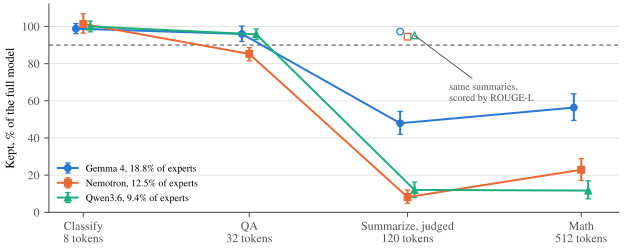
I tested Gemma 4 26B A4B, Nemotron-3.5-Lightning-30B-A3B, and Qwen3.6-35B-A3B on classification, question answering, summarization, and math. The answer depends on the task. With 9 to 19% of the experts, classification and short question answering keep their scores. Summaries and math break at the same budgets. The failure is easy to miss, because the usual score for summaries says they are fine and the text reads well. On one news article, the masked Gemma 4 turns a 73-year-old deputy into a 33-year-old (Table 7).
Solfird AI works on open-weight small models, and the answer decides what such a model must be trained for. If a frozen model can run on a short list, a device could run an open MoE model from a fraction of its expert weights. If it cannot, the routing has to be trained, as in Stepped MoE.
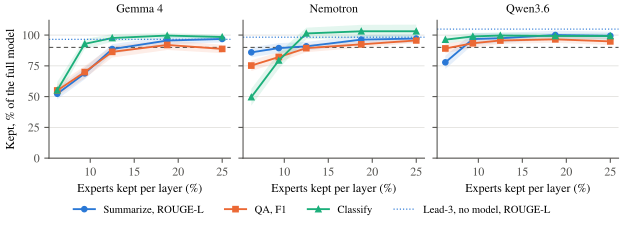
The report follows the order of the work. Section 2 describes the setup. Section 3 finds where the list should come from. Section 4 finds how short it can be. Section 5 runs the same list on summaries and math. Section 6 tests why they break. Section 7 gives the advice, Section 8 the limits, and Section 9 the earlier work. Table 1 lists the results, and Figure 1 shows the main one.
What is new here. Running a frozen MoE model on a subset of its experts is not new. Picking parts of a model from the prompt is not new either. Against the related work (Section 9), this report adds four things.
- A rule to pick the list, with no training. The both-ends rule reads the router on the first and last tokens of the prompt, and refreshes the list as the model writes. Where the list comes from decides whether the method works at all.
- A split by task. On three model families and on held-out items, classification and question answering keep their scores, and summaries and math break at the same budgets. The related work gives one verdict per method, mostly from automatic scores and on one model family.
- A check of the evidence. Each automatic score stands next to a program that uses no model, and blind juries read the summaries. I found neither the split nor this check for frozen MoE models in the related work.
- Two causes, each tested by changing one thing. The list must hold the right experts. And the always-on path, the part of each layer that every token uses, keeps two masked models from looping. None of the related work isolates the always-on path.
| Question | Result | Evidence | Section |
|---|---|---|---|
| What works | |||
| Where should the list come from? | The first and last 32 prompt tokens. On the held-out items, at the smallest budgets, a list from the whole prompt keeps 6.6 to 88.0% on question answering; a list from both ends keeps 85.2 to 96.0% | Held-out | 3 |
| Do classification and short question answering survive at 9 to 19% of the experts? | Yes in 5 of 6 cases: question answering and classification keep 95.8 to 101.3%. Nemotron’s question answering keeps 85.2% | Held-out | 4 |
| What does the list save on a laptop? | Gemma 4 at 24 of 128 experts: 29% of peak memory, same tokens as the masked model; the process still reads the full model once at start | Measured, one model | 4 |
| What breaks | |||
| Do summaries survive? | No: a blind jury of models accepts 8 to 48% as many masked summaries as full-model ones; a second jury, 18 to 63%. ROUGE-L does not show it (94 to 97% kept) | Held-out | 5.1 |
| Does this repeat on a second dataset? | Yes: on XSum the jury accepts 16 to 54% as many | Held-out | 5.1 |
| Do judged summaries come back at larger budgets? | Not shown: with 3/8 of its experts Gemma 4 is undecided; Nemotron with 3/8 and Qwen3.6 with 1/2 stay under the bar | Held-out | 5.1 |
| Does math survive? | No: the models keep 12 to 56% of the full model’s accuracy. With 3/8 of its experts Gemma 4 is undecided | Not held out | 5.2 |
| Why | |||
| Does it matter which experts are kept? | Yes: a random list of the same size fails the short tasks and math, and a fixed list fails once the list is tight | Intervention | 6 |
| What keeps a masked model from looping? | The always-on path: cut by 25%, two masked models loop; the same cut to the routed experts does not do it | Intervention | 6 |
| Why does Nemotron copy the article? | Not explained by the two tests above | Observed | 6 |
2 The setup
This section describes the models, the short list, the tasks, and the scores. The experiment starts in Section 3.
Models. Table 2 lists the three models. All are 4-bit conversions from mlx-community. I ran them with MLX (Apple’s array framework) on one MacBook Pro. Decoding is greedy, and a rerun gave the same tokens. So the uncertainty I report comes from which items were sampled, not from the model.
One part of each model matters later. Every token goes through it, whatever the router decides. In Gemma 4 it is a dense MLP that runs next to the experts. In Nemotron and Qwen3.6 it is the shared experts. I call it the always-on path. The mask never touches it.
| Model | Layers | MoE layers | Experts | Top | Always-on path |
|---|---|---|---|---|---|
| Gemma 4 26B A4B | 30 | 30 | 128 | 8 | Dense MLP |
| Nemotron-3.5-Lightning-30B-A3B | 52 | 23 | 128 | 6 | Shared experts |
| Qwen3.6-35B-A3B | 40 | 40 | 256 | 8 | Shared expert |
The short list. Each MoE layer gets a list of K\('\) experts. The router still scores every expert, but a token can only use experts on the list. In the full model, a token goes to the experts with the highest router scores. Under a list, the scores of the experts outside the list are set to minus infinity before that choice. The token still uses the same number of experts, the best ones on the list, and the model’s own code computes their weights. No weight of the model changes.
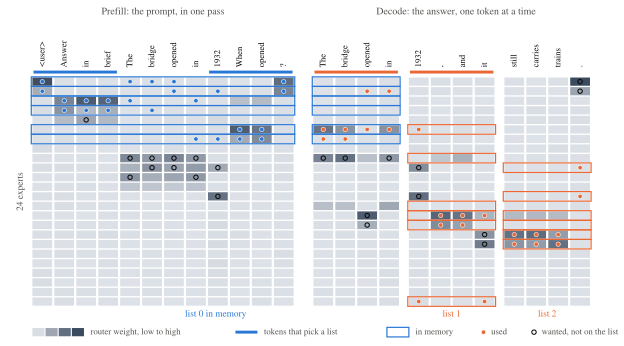
The list comes from the router itself, and each layer keeps its own list. The work follows the two phases of any generation (Figure 2). In prefill, the model reads the whole prompt in one pass. In decode, it writes the answer one token at a time.
Prefill: the prompt, in one pass. At each MoE layer, in order:
- Score. The router scores every expert for every prompt token, before any expert of this layer has run. The weights of a token are the softmax of its scores on Gemma 4 and Qwen3.6, and the normalized weights of its 6 chosen experts (zero for the others) on Nemotron.
- Pick the first list. Add up the weights over the first 32 and the last 32 prompt tokens, or over the whole prompt if it has 64 tokens or fewer. The K\('\) experts with the largest totals form the list. I call this the both-ends rule. Only these experts need to be in memory.
- Run the prompt through the list. Every prompt token goes through its best experts on the list (8 on Gemma 4 and Qwen3.6, 6 on Nemotron). The output goes to the next layer, which repeats steps 1 to 3.
The prompt needs one pass, with no run of the full model, and each layer picks its list from inputs that the lists below it have already changed.
Decode: the answer, one token at a time. At each MoE layer, for each new token:
- Score and run. The router scores every expert, and the token goes through its best experts on the list.
- Keep count. For each expert, including those outside the list, keep a running total of its router weight, computed as in step 1, over the generated tokens. This is how an expert can enter the next list.
- Refresh every 32 tokens. The K\('\) experts with the largest running totals become the new list for the next 32 tokens. Experts that are on both the old and the new list stay in memory, the new ones are loaded, and the totals restart from zero. I write \(S = 32\) for this period.
Two settings in these steps come from tests in Section 3: the two ends of the prompt, and the refresh. The 64 prompt tokens were fixed before the first test of the rule, and I tried no other value.
Tasks. Table 3 lists the tasks. Each has a cap on the length of the answer. Articles are cut to 3,000 characters, and the jurors see the same cut text. XSum is a second summarization set. Its reference summaries are one sentence that rarely repeats the article, so copying the article does not pay there. The stored answers, jury verdicts, logs, and scripts are at https://github.com/solfird/moe-short-lists.
| Task | Dataset | Cap | Score |
|---|---|---|---|
| Classify | AG News [2], four labels | 8 | Accuracy |
| Question answering | SQuAD [3] | 32 | F1 |
| Summarize | CNN/DailyMail [4] | 120 | ROUGE-L, then a jury |
| Summarize, second set | XSum [5] | 120 | ROUGE-L, then a jury |
| Math | GSM8K [6] | 512 | Final-number accuracy |
Three sets of items. For classification, question answering, and CNN/DailyMail summaries, I split the items into three sets of 300, taken by position in the dataset (Appendix E). I used the first set to choose the method. I call these the selection items. I used the second set, the confirmation items, to confirm it. I kept the third set aside, unread, until the method was fixed. Then I wrote down the pass rules and ran it once, together with the first 200 XSum documents. These are the held-out items, and the main results come from them. Math is the exception. It uses the first 200 GSM8K test items, which are not held out.
Scores and the bar. Kept is the masked model’s average score divided by the full model’s score on the same items, in percent. It comes with a 95% confidence interval (CI), computed by bootstrap over the items. Kept can go above 100%. The bar is 90% kept. A result is above the bar when its whole CI is above 90%, under the bar when its whole CI is under 90%, and undecided when its CI includes 90%. I report every result with this strict rule. Earlier, to choose the budgets, I used a looser rule, written before those runs: a point estimate of at least 90%, or a CI that includes 90%.
Checks on the text. Three checks read what an answer contains. An answer loops when its last 24 tokens are one block of at most 12 tokens, repeated. The copied share of an answer is the share of its words that sit in runs of 8 or more words found in the article. A foreign number is a number that does not appear in the article. A foreign name is a capitalized word, not first in its sentence, that does not appear in the article. I also use one baseline with no model: Lead-3, the article’s first three sentences used as a summary.
Juries. Model jurors read each summary next to its article, with no hint of the model or the budget. They answer yes or no to three questions. Is every claim backed by the article? Is the summary condensed, about 2 or 3 sentences with no long copied stretches? Does it cover the main points of the article? An answer is accepted with three yeses. Accepted kept is the masked model’s acceptance rate divided by the full model’s.
Two juries read the answers. The two-member jury is Claude Haiku 5.5 and Ministral-3 8B, a local model, and an answer counts only if both accept it. I fixed this jury before the held-out and XSum runs, and it decides their pass rules. The three-vendor jury is GPT-5.6 Luna, Gemini 3.5 Flash-Lite, and Claude Haiku 5.5, with the majority on each question. It reads every held-out answer as a check. No juror is a model under test. Appendix A gives the full design.
3 Step 1: where the list comes from
Evidence: selection items to choose the rule, then confirmation and held-out items to test it.
The first thing to settle was which prompt tokens should pick the list.
A list picked from every token of the prompt fails when the prompt is long. My first rule was the obvious one: use every token of the prompt. I added up the router’s weights over all of them and kept the experts with the largest totals. This works when the prompt is short, such as a headline to classify. It fails when the prompt is long, such as a question with its passage (Table 4, column “Whole prompt”). On question answering, Qwen3.6 loses most of its score, and Gemma 4 loses a third. Under this rule, most of Gemma 4’s summaries also loop.
A padding test shows that the choice of tokens is part of the problem. I put unrelated text in front of a classification prompt and built the list in two ways. Built from all the tokens, padding included, the list never gives the full model’s first answer token, on any of 200 items. Built from the original prompt tokens only, with the padding still going through the mask, it gives that token on more than half of the items on Gemma 4 and Qwen3.6. So the damage comes in part from which tokens pick the list. My reading: in a long prompt, the tokens of the article outnumber those of the instruction and the question, so a list built from all tokens fits the article and not the task.
A list picked from the two ends of the prompt works. The instruction and the question sit at the ends of the prompt, so I tried the ends. Neither end is enough alone: the last 64 tokens lose classification on Nemotron, and the first 64 lose both tasks on Qwen3.6. The first 32 and the last 32 together give the best result in every row of Table 4. This is the both-ends rule.
More information does not reliably help. I also built a list with knowledge of the full model’s answer. It is ahead of the both-ends rule on one model and far behind on summaries on the other two (Appendix C).
| Model | Task | Whole prompt | First 64 | Last 64 | First 32 and last 32 |
|---|---|---|---|---|---|
| Gemma 4, K\('\) = 16 | QA F1 | 64.2 | 71.0 | 81.1 | 86.4 [81.7, 91.0] |
| Classify | 95.2 | 96.0 | 87.3 | 97.6 [94.5, 100.8] | |
| Nemotron, K\('\) = 16 | QA F1 | 84.0 | 79.8 | 87.3 | 89.4 [86.1, 92.5] |
| Classify | 84.2 | 88.2 | 61.4 | 101.3 [96.6, 106.0] | |
| Qwen3.6, K\('\) = 32 | QA F1 | 15.7 | 8.5 | 89.9 | 95.6 [92.8, 98.4] |
| Classify | 98.5 | 20.6 | 97.0 | 99.6 [97.1, 102.2] |
The rule holds on items I had not used. I chose the rule after I read these results, on the same items. So its real test is on the other two sets. On the confirmation items, the gains repeat (Table 19). On the held-out items, I wrote the test and its pass rule before the run. Table 5 gives the result: on each model, the both-ends list is ahead on at least one of the two tasks, and it is behind on none. The size of the gain depends on the model. The largest is on Qwen3.6, where the whole-prompt list loses question answering almost entirely. The summaries show the same order: under the whole-prompt list, more than half of Gemma 4’s summaries loop, and under the both-ends list almost none do.
| Model | Task | Whole prompt | First 32 and last 32 | Difference |
|---|---|---|---|---|
| Gemma 4, K\('\) = 24 | QA F1 | 88.0 [83.8, 92.3] | 96.0 [91.9, 100.2] | +5.7 [2.7, 8.8] |
| Classify | 98.0 [95.3, 100.8] | 98.8 [96.2, 101.5] | +0.7 [-1.3, 2.7] | |
| Nemotron, K\('\) = 16 | QA F1 | 83.4 [79.6, 87.0] | 85.2 [81.5, 88.7] | +1.8 [-1.6, 5.1] |
| Classify | 90.6 [85.3, 96.2] | 101.3 [96.4, 106.9] | +8.0 [3.7, 12.3] | |
| Qwen3.6, K\('\) = 24 | QA F1 | 6.6 [4.3, 9.2] | 95.8 [92.9, 98.6] | +81.1 [77.6, 84.6] |
| Classify | 96.9 [93.4, 100.4] | 100.0 [97.1, 102.9] | +2.7 [0.7, 4.7] |
The list must change as the model writes. A long answer moves away from the prompt, so I refresh the list from the tokens the model has just written. I tested this once, early, on math with Gemma 4. Accuracy fell as I refreshed less often, from 37.5% with a refresh every 32 tokens to 3.5% with no refresh (Table 19). Classification and question-answering answers end before the first refresh, so one list per prompt serves them.
With the rule fixed, the next question was the size of the list.
4 Step 2: how short the list can be
Evidence: held-out items, except the laptop memory measurement, which covers one model.
I wanted the smallest list that keeps classification and question answering above the bar.
Choosing the budgets. On the selection items, I lowered the number of experts step by step. The scores stay nearly flat down to a small share of the experts. Below it, some fall off a cliff (Figure 7 in the appendix). I took the smallest budget that met the looser rule on each model. Table 6 gives them: between 9 and 19% of the experts, depending on the model. One budget moved. On Gemma 4, the first budget passed on the selection items and missed on the confirmation items, so I raised it before the held-out run. For Gemma 4, only the held-out items confirm the budget.
The held-out test. I then ran the held-out items once (Table 6). Classification is above the bar on all three models. Question answering is above the bar on Gemma 4 and Qwen3.6, and under it on Nemotron. So 5 of 6 cases pass. The table also shows summaries above the bar by ROUGE-L. Keep that in mind: Section 5 shows that it is not a pass.
| Model | Set | Summarize, ROUGE-L | QA F1 | Classify |
|---|---|---|---|---|
| Gemma 4, K\('\) = 24/128 | Confirmation | 96.0 [93.0, 99.0] | 92.7 [88.7, 96.5] | 99.2 [95.6, 103.0] ▲ |
| Held-out | 97.2 [94.5, 100.1] | 96.0 [91.9, 100.2] ▲ | 98.8 [96.2, 101.5] ▲ | |
| Nemotron, K\('\) = 16/128 | Confirmation | 90.3 [86.3, 94.5] | 90.3 [87.2, 93.3] | 93.0 [87.8, 98.2] |
| Held-out | 94.5 [90.9, 98.5] | 85.2 [81.5, 88.7] ▼ | 101.3 [96.4, 106.9] ▲ | |
| Qwen3.6, K\('\) = 24/256 | Confirmation | 92.5 [87.6, 97.6] | 95.0 [92.1, 97.6] ▲ | 96.5 [93.7, 99.2] ▲ |
| Held-out | 95.2 [90.1, 100.4] | 95.8 [92.9, 98.6] ▲ | 100.0 [97.1, 102.9] ▲ |
The tasks are not just easy. A pass could mean only that the task is easy. So I scored two programs that use no model: answer with the first sentence of the context, and always answer the most common label. Both stay far under the bar (Table 19). Classification also holds when I change the order of the labels and when I use a second label set, in a probe that scores the first answer token. So the result does not depend on one way of writing the prompt.
Memory on a laptop. A mask alone saves no memory, because every expert stays loaded. To see what a short list can save, I wrote a loader for Gemma 4. It keeps only the listed experts of each layer in memory and reads the new ones from the checkpoint files at each refresh. Its tokens are identical to the masked model’s on the 20 held-out summaries I ran. Once the model is loaded, with 24 experts per layer, peak MLX memory is 29% of the full model’s. But the process still loads the full model once at start, so the highest memory use over its whole life does not change. Two earlier runs are void: one swapped in a new list one token early, and one read the files through a memory map that grew the process (Table 19).
For a builder, this is the usable result: a classifier or an extractive question-answering system can run from a fraction of an MoE model’s experts, with no training.
The budgets were chosen on short answers. The next step runs the same lists on summaries and math.
5 Step 3: the same list on summaries and math
Evidence: held-out items and a second dataset for summaries; the first 200 test items for math, which are not held out.
The automatic score said that the summaries had passed. I did not trust one score, so I read them.
5.1 Summaries read well and are wrong
What the summaries look like. Table 7 shows four summaries of one article. The full Gemma 4 gets the facts right. The masked Gemma 4 writes a clean sentence with two wrong ages. The masked Qwen3.6 gives the deputy’s age to the victim, then pastes the article until it runs out of tokens. On another article it loops on one digit.
| Source | Text |
|---|---|
| Article | “a 73-year-old reserve deputy, Robert Bates, killed Eric Harris.” A later paragraph recalls a 2009 case in which a 22-year-old was killed. |
| Gemma 4, full | A 73-year-old reserve deputy in Tulsa, Oklahoma, is facing manslaughter charges after accidentally shooting and killing Eric Harris while attempting to use a Taser. |
| Gemma 4, K\('\) = 24 | A 33-year-old reserve deputy Robert Bates accidentally fired his handgun instead of his Taser, killing 22-year-old Eric Harris in Tulsa, Oklahoma. |
| Qwen3.6, K\('\) = 24 | A Tulsa, Oklahoma police officer accidentally fired a handgun instead of a Taser, killing 73-year-old Eric Harris. […] “Oh! I shot him. I’m sorry,” Bates said in a video of the shooting. But it’s happened before. In a well-publicized 2009 case, […] (copies the article until the length cap) |
| Qwen3.6, K\('\) = 24, item 459 | An Alaska Airlines employee accidentally fell asleep in the cargo hold on a flight, causing a emergency landing and a 99999999999999999999… (loops until the cap) |
These examples show two ways to fail. Gemma 4 keeps the form: its summaries stay short and cover the main points, but the facts change. Nemotron and Qwen3.6 lose the form too: more than half of their answers are mostly copied from the article, against none for the full models (Table 11 in the appendix).
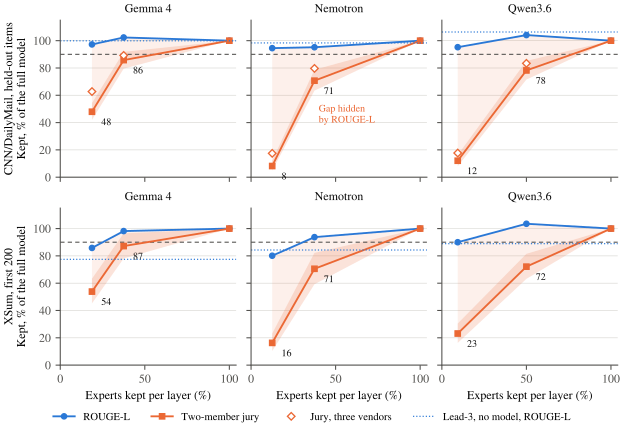
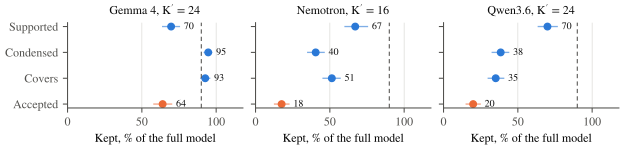
A blind jury rejects most of them. A few examples prove nothing, so I had every summary judged (Table 8, Figure 3). The two-member jury accepts about half as many of Gemma 4’s masked summaries as of its full-model summaries. For Nemotron and Qwen3.6, it accepts about one in ten. The three-vendor jury is more lenient and reaches the same verdict. It gave the same result on the confirmation items, so the verdict is not a property of one set of items. Removing any one juror, or requiring all three to agree, moves every result further under the bar (Table 12).
| Overlap score | Accepted by a jury | ||||
|---|---|---|---|---|---|
| Model | ROUGE-L | Lead-3 | Two-member | Three-vendor | XSum |
| Gemma 4, K\('\) = 24 | 97.2 | 99.9 | 47.9 [42.0, 54.3] ▼ | 62.7 | 53.8 |
| Nemotron, K\('\) = 16 | 94.5 | 98.3 | 8.2 [4.9, 12.0] ▼ | 17.5 | 16.3 |
| Qwen3.6, K\('\) = 24 | 95.2 | 106.4 | 12.1 [8.0, 16.2] ▼ | 17.7 | 23.1 |
Two checks with no judge agree in part. The jurors are models, so I also counted two things that need no judge. First, numbers. On Gemma 4 and Qwen3.6, a number written under the mask is absent from the article far more often than a number written by the full model. On Nemotron it is not. Second, copying, which the paragraph above describes for Nemotron and Qwen3.6. These checks explain only part of the verdict: most of the answers that fail the jury’s first question, support, contain no foreign number and no foreign name (Table 19).
A second dataset gives the same verdict. CNN/DailyMail reference summaries resemble the opening of the article, so copying is rewarded there. XSum does not reward it. I wrote the pass rules first and ran the first 200 XSum documents. The jury again rejects most masked summaries (Table 8), and Nemotron and Qwen3.6 again copy. So the verdict does not depend on one dataset.
A larger list is not shown to fix it. I then gave each model a much larger list: three eighths of the experts for Gemma 4 and Nemotron, and half for Qwen3.6. Gemma 4 is undecided under both juries. The other two stay under the bar (Table 10 in the appendix). Sample size matters for this reading. On 100 items, Nemotron’s interval was wide enough to count as a pass under the looser rule. On 300 items it is under the bar.
Why ROUGE-L did not show it. ROUGE-L counts the words that a summary shares with the reference. On CNN/DailyMail, the opening of the article shares as many as a real summary does. Table 8 shows it: Lead-3, which is no summary at all, scores as well as the full model. So a masked model that copies the article keeps its ROUGE-L. Inside one masked model, ROUGE-L cannot even tell the accepted answers from the rejected ones. The other ROUGE variants say the same (Table 13). On XSum, where copying does not pay, ROUGE-L sees part of the damage (Figure 3, bottom). This weakness of overlap scores is known (Section 9). What I add is that it hides the failure of a reduced MoE model. A ROUGE-L result alone is not evidence that such a model still summarizes.
The limit of this section. The jurors are models. No person graded these summaries, and the two juries share one juror. On public summaries with human labels, the jurors agree with experts on CNN/DailyMail and are much stricter than the annotators on XSum (Section 8).
5.2 Math fails too
Table 9 gives GSM8K with the same lists. Every model is under the bar at its first budget. A larger list helps Gemma 4, which becomes undecided at three eighths of its experts. It does not help Qwen3.6, which stays flat and loops on about 40% of its answers. So the size of the list is not its only limit. These are the first 200 test items, not held-out ones. The test also mixes arithmetic with the reading of a word problem, and Section 6 separates the two.
| Model | K\('\) | Kept (%) [95% CI] | Loops (%) |
|---|---|---|---|
| Gemma 4 | 24 | 56.4 [49.5, 63.7] ▼ | 4.0 |
| 32 | 72.3 [65.9, 78.6] ▼ | 2.5 | |
| 48 | 88.3 [82.5, 93.4] | 0.5 | |
| Nemotron | 16 | 22.9 [17.2, 28.9] ▼ | 4.0 |
| 24 | 37.0 [30.2, 43.6] ▼ | 3.0 | |
| 32 | 46.9 [39.6, 54.1] ▼ | 2.0 | |
| Qwen3.6 | 24 | 11.7 [7.3, 17.0] ▼ | 38.5 |
| 32 | 14.0 [8.8, 19.8] ▼ | 42.0 | |
| 48 | 13.5 [8.3, 18.9] ▼ | 36.5 |
Summaries and math break with the lists that serve classification and question answering, and a larger list does not clearly repair them. The next step tests why.
6 Step 4: why it breaks
Evidence: tests that change one thing at a time, and two observations.
I wanted to know what a short list takes away. I ran two tests, each changing one thing, at the first budgets and with no training.
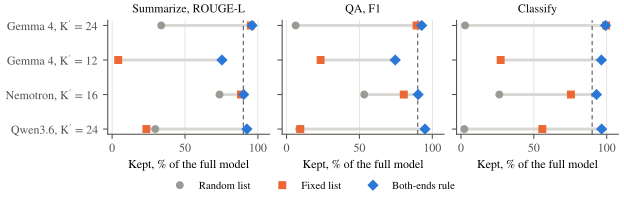
Test 1: does it matter which experts are on the list? If many experts could do the easy tasks, any list of the same size would pass them. So I replaced each list with experts drawn at random, refreshed on the same schedule. Every task fails on every model (Figure 4, grey). Even classification, the easiest task, falls close to zero on two models.
A random list is a blunt test. So I also tried a sensible list that ignores the prompt: for each layer, the experts that the router uses most on other prompts, fixed for every item and never refreshed (Figure 4, orange). On Nemotron and Qwen3.6, this fixed list loses to the both-ends rule. On Gemma 4, the two lists score the same. But Gemma 4 has the largest list of the three, as a share of its experts. When I cut its list to the share that Qwen3.6 has, the fixed list fails on Gemma 4 too (Table 19). So once the list is tight, picking it from the prompt matters on every model. One caveat: the fixed list differs from the both-ends rule in two ways, where it comes from and that it is never refreshed, and I did not separate the two.
Experts are not interchangeable. Two measurements on the full models, with nothing changed, fit this result (Appendix C). Different experts give different outputs for the same token. And the router’s choice follows the kind of token (words, numbers, punctuation, prompt template) more than the task, which agrees with OpenMoE [7]. My reading: a list picked from the prompt works when it holds the experts that the prompt’s kinds of tokens use, not because any expert can do the task.
What the mask does to arithmetic. GSM8K mixes two skills: reading a word problem and computing over many tokens. To separate them, I generated plain arithmetic of three lengths, which the full models solve (Table 15 in the appendix). Gemma 4 keeps its accuracy at every length. So its math loss comes from the word problems, not from the arithmetic. Nemotron and Qwen3.6 lose part of their accuracy on a single operation, and almost all of it on a running total, where each step is one addition.
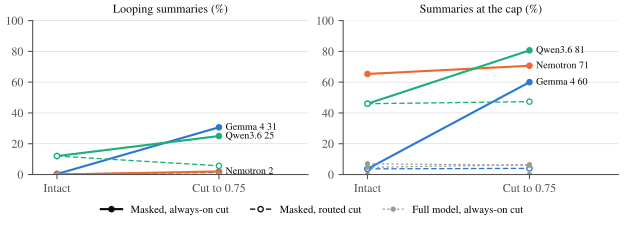
Test 2: what does the always-on path do? The mask never touches the always-on path. To see what it contributes, I scaled its output down by a quarter and changed nothing else (Figure 5, solid lines). The full models barely notice. Two masked models react strongly: on Gemma 4 and Qwen3.6, many more summaries loop or run to the length cap. The control is the same cut applied to the routed experts instead (dashed lines), and it changes little. Because I changed only one thing, the cut causes the extra loops. With the mask on, the always-on path at full strength keeps these two models from looping more.
Three notes on this test. The two outputs do not have the same size, so the same factor is not the same amount of change. Nemotron moves little, but its masked summaries already hit the cap two times in three, so there is little room to see an effect. And the result fits DeepSeekMoE’s finding that a routed expert cannot replace the shared one [8]. Table 17 gives the numbers.
What I could not explain. Three things remain open. I do not know why Nemotron copies instead of looping: neither its always-on path nor its smaller number of masked layers explains it in my tests (Appendix C). Gemma 4 leans more on its always-on path than the other two (Table 19), which fits its tolerance of a fixed list, but this is a pattern in the data, not a tested cause. And I do not know how much of the loss of support comes from missing experts and how much from the always-on path, because I scored that test with automatic scores only.
These tests say where a repair must act. The next section turns the results into advice.
7 What to do
A frozen MoE model runs on a short list of experts for classification and short question answering, and not for summaries or math. That gives two pieces of advice for a builder and one direction for the next report.
Use a short list today for classification and short question answering. Pick the list from both ends of the prompt, with no training. With 9 to 19% of the experts, 5 of 6 cases keep their scores. Confirm the budget on your own task before you rely on it: put a no-model baseline next to the score, and use enough held-out items. A result that looked like a pass on 100 items did not survive 300.
Do not trust a claim about generation quality without two checks. Summaries and math break at the same budgets, and the automatic score for summaries did not show it. A claim that a reduced MoE model keeps its quality on a generation task needs a no-model baseline next to the score. It also needs outputs that are judged for support and form, not only scored.
What a repair must do. The tests of Section 6 say what is missing. A repair must keep, for each kind of token, the experts that it uses. It must keep step-by-step computation working. And it must keep generation from looping when the list is small. A frozen model gives two levers, the size of the list and the rule that picks it. With neither one did I bring summaries or math back above the bar. The next lever is training: teach the router to work from a short list, and teach the masked model to stop. That is the subject of the next report in this series.
8 Limits
The juries are models. No person graded the summaries of this report. Model judges have known biases [9, 10], and the jurors differ in strictness. The verdict at the first budgets is far from the bar and survives every jury I tried. To tie the jury to human readers, I ran the same jurors on public summaries that people have labeled for factual support, with a pass rule written first (Table 14). The test does not pass. On SummEval [11], the two-member jury agrees with the experts on about nine summaries in ten. On the XSum annotations of Maynez et al. [12], it agrees on about two in three: it catches almost every unsupported summary, and it also rejects most of the summaries that the annotators found faithful. I did not establish why. A strict jury lowers both the masked and the full-model acceptance rates, but not always by the same share, so it can still move the ratio I report. This test covers factual support only, on summaries from systems of 2017 to 2019.
Task and length are mixed. The tasks with long answers are also the harder ones, and I did not vary the length of the answer within one task. One count goes part of the way, with its rule written first. I looked only at the first 24 words of each held-out summary, about the length of a short answer. The damage is already there on three of four checks: foreign numbers on Gemma 4, and copying on Nemotron and Qwen3.6 (Table 19). It is also larger later in the summary. So a masked summary is wrong before it is long, and it gets worse as it goes on. My reading is that the split is first by task and second by length.
Items. The held-out items and XSum were each scored once for the main results, after the method was fixed. I used the held-out items a second time for the comparison with the whole-prompt list (Table 5), under a rule written before that run. Classification and question answering rest on automatic scores, with a no-model baseline checked. The juries cover summaries only.
Scope. One quantization (4-bit), text input only, one machine, English, greedy decoding. Loops are a known failure of greedy decoding; the full 4-bit models loop on none of these answers. Budgets are expert counts. Memory is measured on Gemma 4 only, on 20 items. The 90% bar is a convention. The budgets were chosen with a looser rule than the one used to report results (Section 2). All results are for frozen models: Section 6 says why they fail, not whether training repairs them.
9 Related work
This section places the report against earlier work. What is new is listed in Section 1.
Models built or adapted for small sets of experts. Three works are closest. Stepped MoE [1] pretrains a model to use one set of experts per segment of text. A learned selector picks the set after it reads one token. SwapMoE [13] puts a hard cap on off-the-shelf models without changing their weights, and updates the set from time to time. It reports summarization on one overlap score only, Rouge-2. Temporally Extended MoE [14] masks an existing checkpoint and rescales the router weights inside the allowed set, as I do. It also trains a controller and LoRA adapters, which are small added weights.
Pruning and skipping experts. These methods remove experts for every input [15, 16]. REAP reports near-lossless code generation and tool calling after it prunes half of the experts, a much larger budget than the 9 to 19% I study. Steimle et al. [17] find that a plain, fixed reduction of active experts is hard to beat among dynamic skipping methods.
Several works ask why pruning hurts. Hyeon and Do [18] argue that the cause is a mismatch between the router and the changed experts, and show that retraining the router recovers part of the loss. He et al. [19] start from the view that removing whole experts breaks the routing structure, so they prune inside experts instead. Zhang [20] start from the view that outputs come from combinations of experts, and score those combinations. Goel et al. [21] model the path of a token through the experts as a Markov chain. Su et al. [22] find that skipping three of 6,144 experts in Qwen3-30B-A3B makes the model repeat itself until it reaches the length cap. That fits the loops I measure.
The pruning works have three things in common. First, they remove, compress, or merge a fixed set of experts for every input, in two cases with a light recovery step. Second, they score the result with automatic benchmark metrics. Only Su et al. also read sample outputs, not blind and not as a jury. Third, none of them compares tasks with short answers and tasks with long ones, has the outputs judged by a blind jury, or isolates the always-on path. Su et al. remove shared experts in DeepSeek-R1, but only together with routed experts.
Picking from the prompt. The closest idea comes from dense models. GRIFFIN [23] picks half of the feed-forward neurons of a dense model from their activations over the whole prompt. It needs no training and keeps that choice for the whole generation. It reports classification, question answering, and ROUGE on XSum and CNN/DailyMail close to the full model’s. It tests no model with a router.
The both-ends rule applies the same idea to the experts of an MoE model. The signal is the router’s own weights, and the budget is 9 to 19% of the experts in place of half of the neurons. It differs from GRIFFIN in three ways, and each rests on a test in this report. It reads the two ends of the prompt, because at these budgets the whole prompt is the wrong source (Table 4). It refreshes the list during generation, because on math a list that is never refreshed loses almost all of its accuracy (Section 3). And its summaries are judged, because ROUGE on these two datasets does not show when summaries break (Section 5.1).
What experts do. The sources disagree, by model and by measure. Routing in Mixtral [24] and in OpenMoE [7] follows syntax and token identity more than topic. Chen and Yao [25] report domain specialization in Qwen3.6-35B-A3B. DeepSeekMoE [8] shows that a routed expert cannot replace the shared one. Bai et al. [26] report experts that specialize in using the context given in the prompt. That is close to the damage I measure, although they do not test masks.
What overlap scores see. The weakness of ROUGE on summaries is known. On CNN/DailyMail, See et al. [27] already note that the Lead-3 baseline is hard to beat. SummEval [11] finds ROUGE-L the weakest ROUGE variant against expert judgments of consistency. FRANK [28] finds a low correlation with factuality. Maynez et al. [12] and Kryściński et al. [29] argue that overlap does not capture faithfulness. None of these works claims that ROUGE never tracks facts, and I do not either. In the MoE setting, Kapusuzoglu et al. [30] show a similar problem: under pruning, perplexity can point the wrong way on task accuracy. Model judges have known biases too [9, 10], so a jury is also a proxy. Section 8 comes back to this.
Acknowledgments
This work had no funding from any model vendor, and none reviewed it. I chose the question and the models, decided which experiments to run, and reviewed the results and the text. I used generative AI to draft this text. One of the jurors, Claude Haiku 5.5, comes from the vendor of the AI tool I used. All errors are mine.
References
[1] Arnav Kundu, Zhaoyang Xu, Bairu Hou, Chang Gao, Reed Li, and Tao Lei. Stepped MoE: Segment-level routing with configurable inference complexity, 2026.
[2] Xiang Zhang, Junbo Zhao, and Yann LeCun. Character-level convolutional networks for text classification, 2015.
[3] Pranav Rajpurkar, Jian Zhang, Konstantin Lopyrev, and Percy Liang. SQuAD: 100,000+ questions for machine comprehension of text, 2016.
[4] Karl Moritz Hermann, Tomáš Kočiský, Edward Grefenstette, Lasse Espeholt, Will Kay, Mustafa Suleyman, and Phil Blunsom. Teaching machines to read and comprehend, 2015.
[5] Shashi Narayan, Shay B. Cohen, and Mirella Lapata. Don’t give me the details, just the summary! Topic-Aware convolutional neural networks for extreme summarization, 2018.
[6] Karl Cobbe, Vineet Kosaraju, Mohammad Bavarian, Mark Chen, Heewoo Jun, Lukasz Kaiser, Matthias Plappert, Jerry Tworek, Jacob Hilton, Reiichiro Nakano, Christopher Hesse, and John Schulman. Training verifiers to solve math word problems, 2021.
[7] Fuzhao Xue, Zian Zheng, Yao Fu, Jinjie Ni, Zangwei Zheng, Wangchunshu Zhou, and Yang You. OpenMoE: An early effort on open mixture-of-experts language models, 2024.
[8] Damai Dai, Chengqi Deng, Chenggang Zhao, R. X. Xu, Huazuo Gao, Deli Chen, Jiashi Li, Wangding Zeng, Xingkai Yu, Y. Wu, Zhenda Xie, Y. K. Li, Panpan Huang, Fuli Luo, Chong Ruan, Zhifang Sui, and Wenfeng Liang. DeepSeekMoE: Towards ultimate expert specialization in mixture-of-experts language models, 2024.
[9] Lianmin Zheng, Wei-Lin Chiang, Ying Sheng, Siyuan Zhuang, Zhanghao Wu, Yonghao Zhuang, Zi Lin, Zhuohan Li, Dacheng Li, Eric P. Xing, Hao Zhang, Joseph E. Gonzalez, and Ion Stoica. Judging LLM-as-a-judge with MT-Bench and Chatbot Arena, 2023.
[10] Ryan Koo, Minhwa Lee, Vipul Raheja, Jong Inn Park, Zae Myung Kim, and Dongyeop Kang. Benchmarking cognitive biases in large language models as evaluators, 2023.
[11] Alexander R. Fabbri, Wojciech Kryściński, Bryan McCann, Caiming Xiong, Richard Socher, and Dragomir Radev. SummEval: Re-evaluating summarization evaluation, 2020.
[12] Joshua Maynez, Shashi Narayan, Bernd Bohnet, and Ryan McDonald. On faithfulness and factuality in abstractive summarization, 2020.
[13] Rui Kong, Yuanchun Li, Qingtian Feng, Weijun Wang, Xiaozhou Ye, Ye Ouyang, Linghe Kong, and Yunxin Liu. SwapMoE: Serving off-the-shelf MoE-based large language models with tunable memory budget, 2023.
[14] Zeyu Shen and Peter Henderson. Temporally extended mixture-of-experts models, 2026.
[15] Xudong Lu, Qi Liu, Yuhui Xu, Aojun Zhou, Siyuan Huang, Bo Zhang, Junchi Yan, and Hongsheng Li. Not all experts are equal: Efficient expert pruning and skipping for mixture-of-experts large language models, 2024.
[16] Mike Lasby, Ivan Lazarevich, Nish Sinnadurai, Sean Lie, Yani Ioannou, and Vithursan Thangarasa. REAP the experts: Why pruning prevails for one-shot MoE compression, 2025.
[17] Jakob Steimle, Thomas Elsken, Daniel Ehrhardt, Lukas Rinder, Daniel Cremers, and Xi Wang. Don’t skip the baseline: A controlled comparison of dynamic expert skipping in MoEs, 2026.
[18] Sieun Hyeon and Jaeyoung Do. Is retraining-free enough? the necessity of router calibration for efficient MoE compression, 2026.
[19] Jiangyang He, Shaolin Zhu, and Deyi Xiong. TENP: Trapezoidal expert neuron pruning for mixture-of-experts, 2026.
[20] Yuhao Zhang. SHAPE: Coalition-aware expert pruning for sparse mixture-of-experts LLMs, 2026.
[21] Palaash Goel, Ayush Maheshwari, and Tanmoy Chakraborty. It takes a MAESTRO to prune bad experts, 2026.
[22] Zunhai Su, Qingyuan Li, Hao Zhang, Weihao Ye, Qibo Xue, YuLei Qian, Yuchen Xie, Ngai Wong, and Kehong Yuan. Unveiling super experts in mixture-of-experts large language models, 2025.
[23] Harry Dong, Beidi Chen, and Yuejie Chi. Prompt-prompted mixture of experts for efficient LLM generation. arXiv preprint arXiv:2404.01365, 2024.
[24] Albert Q. Jiang, Alexandre Sablayrolles, Antoine Roux, Arthur Mensch, Blanche Savary, Chris Bamford, Devendra Singh Chaplot, Diego de las Casas, Emma Bou Hanna, Florian Bressand, Gianna Lengyel, Guillaume Bour, Guillaume Lample, Lélio Renard Lavaud, Lucile Saulnier, Marie-Anne Lachaux, Pierre Stock, Sandeep Subramanian, Sophia Yang, Szymon Antoniak, Teven Le Scao, Théophile Gervet, Thibaut Lavril, Thomas Wang, Timothée Lacroix, and William El Sayed. Mixtral of experts, 2024.
[25] Xing Chen and Hengshuai Yao. Training-free halving of activated experts in fine-grained mixture-of-experts models, 2026.
[26] Jun Bai, Minghao Tong, Yang Liu, Zixia Jia, and Zilong Zheng. Understanding and leveraging the expert specialization of context faithfulness in mixture-of-experts LLMs, 2025.
[27] Abigail See, Peter J. Liu, and Christopher D. Manning. Get to the point: Summarization with pointer-generator networks, 2017.
[28] Artidoro Pagnoni, Vidhisha Balachandran, and Yulia Tsvetkov. Understanding factuality in abstractive summarization with FRANK: A benchmark for factuality metrics, 2021.
[29] Wojciech Kryściński, Bryan McCann, Caiming Xiong, and Richard Socher. Evaluating the factual consistency of abstractive text summarization, 2019.
[30] Berkcan Kapusuzoglu, Connor Pryor, Sangwoo Cho, Supriyo Chakraborty, Shi-Xiong Zhang, Sambit Sahu, and Milind Naphade. When load-balancing goes too far: Expert pruning in over-dispersed mixture-of-experts models, 2026.
A Jury design
What the jurors do. Model jurors read each summary next to its article, with no hint of the model or the budget. They answer yes or no to three questions. Is every claim backed by the article (supported)? Does the summary give the main points in about 2 or 3 sentences, without long copied stretches (condensed)? Does it state the main points (covers)? An answer is accepted with three yeses. I report accepted kept: the masked model’s acceptance rate divided by the full model’s.
Two juries. The two-member jury is Claude Haiku 5.5 and Ministral-3 8B, a local model. An answer counts only if both accept it. I fixed this jury before the held-out and XSum runs, and it decides their pass rules. The three-vendor jury is GPT-5.6 Luna, Gemini 3.5 Flash-Lite, and Claude Haiku 5.5, with the majority on each question. It read every held-out answer as a check. The two juries give the same verdict on 90.1% of the 2,700 held-out answers.
Independence. No juror is a model under test. The Claude juror comes from the vendor of the AI tool I used in this work. So Appendix B gives every verdict without it.
B Jury robustness and ROUGE variants
Jury details. The 2,700 held-out answers are three models, each as the full model and at two budgets, on 300 items. The three-vendor jury also judged the selection and confirmation items. The Claude juror reads blind batches of 50 answers, built so that no article appears twice in a batch. The two juries share the Claude juror. Without it, the local juror alone and the pair of Luna and Flash-Lite agree on 70.5% of answers.
Without the Claude juror. At the first budgets, the verdict does not depend on the Claude juror: the local juror alone and the pair of Luna and Flash-Lite both put every model far under the bar (Table 19). At the larger budgets, the reading depends on the jury. Table 10 gives each one: without the Claude juror, the two remaining readings disagree on Nemotron.
| Model | Two-member jury | Three-vendor jury | XSum | Local juror | Luna and Flash-Lite | Copied |
|---|---|---|---|---|---|---|
| Gemma 4, K\('\) = 48 | 85.8 [79.5, 91.8] | 89.2 [84.5, 94.0] | 87.2 | 90.8 | 81.4 | 0 |
| Nemotron, K\('\) = 48 | 70.7 [63.4, 78.7] ▼ | 79.7 [72.5, 87.3] ▼ | 70.5 | 87.0 | 70.3 | 7 |
| Qwen3.6, K\('\) = 128 | 78.2 [71.5, 85.2] ▼ | 83.4 [77.6, 89.6] ▼ | 72.1 | 86.2 | 86.9 | 3 |
| Gemma 4, K\('\) = 24 | Nemotron, K\('\) = 16 | Qwen3.6, K\('\) = 24 | |
|---|---|---|---|
| ROUGE-L kept (%) | 96.0 | 90.3 | 92.5 |
| Accepted kept (%) | 64.0 | 17.6 | 19.9 |
| Copied words (%) | 4.9 / 2.8 | 53.1 / 4.8 | 50.5 / 3.2 |
| Answers over 50% copied, of 300 | 5 / 0 | 164 / 0 | 174 / 0 |
| Answers at the 120-token cap, of 300 | 9 / 0 | 193 / 18 | 178 / 20 |
| Loops (%) | 1.0 / 0 | 2.0 / 0 | 17.7 / 0 |
| Cell | Majority | Unanimous | No Luna | No Flash-Lite | No Claude | First pass |
|---|---|---|---|---|---|---|
| Gemma 4, K\('\) = 24 | 64.0 | 47.3 | 56.8 | 52.7 | 48.3 | 66.0 |
| Nemotron, K\('\) = 16 | 17.6 | 10.2 | 11.1 | 11.4 | 12.6 | 21.5 |
| Qwen3.6, K\('\) = 24 | 19.9 | 10.2 | 13.9 | 14.6 | 10.6 | 21.5 |
| Gemma 4, K\('\) = 32 | 77.2 | 56.3 | 71.7 | 58.6 | 61.2 | 79.9 |
| Nemotron, K\('\) = 32 | 58.2 | 39.4 | 54.0 | 41.3 | 41.2 | 58.1 |
| Qwen3.6, K\('\) = 64 | 54.5 | 40.1 | 51.0 | 41.2 | 40.4 | 52.1 |
C Secondary results
These results support the main text and are not needed to follow it. Table 19 gives their numbers.
A list picked from the full model’s answer is not a ceiling. I built a list with knowledge of the answer that the full model gives, at tight budgets, on the selection items. On Nemotron it is ahead of the both-ends rule on question answering and classification. On Gemma 4 and Qwen3.6 it is far behind on summaries. On these two models, it also matches the full model’s first summary token less often than the both-ends rule does. My reading, which I did not test as such: the first token decides much of what follows, and a list weighted toward the answer loses the experts that the last prompt tokens need.
Loops are not a Qwen3.6 problem alone. Qwen3.6 loops on many summaries at its first budget. Most of these loops start before the first refresh of the list, so refreshing does not start them. With the same share of its experts, Gemma 4 loops too. Nemotron stays near 2% at every share I tested. Section 6 shows that the always-on path holds back these loops.
Experts give different outputs, and routers group tokens by type. Two measurements on the full models, with nothing changed, fit the random-list result. First, different experts give different outputs for the same token. Two experts agree on the same token barely more than on different tokens, far under the threshold that I set in advance for shared work (Table 18). Second, the router’s favorite experts depend more on the kind of token (words, numbers, punctuation, prompt template) than on the task. Take one kind of token, such as numbers. The router’s lists for numbers overlap more between two tasks than the lists for numbers and for words overlap within one task. This agrees with OpenMoE’s finding that experts specialize by token [7]. The task still matters: the overlap across tasks stays well below the overlap that two random halves of the same task reach. My reading: a list picked from the prompt works when it holds the experts that the prompt’s kinds of tokens use, not because any expert can do the task.
Masking fewer layers helps, but does not explain Nemotron. Nemotron has experts in fewer than half of its layers, so its mask touches fewer layers than the other two. To test whether that matters, I masked Gemma 4 on fewer than half of its layers, evenly spaced. Compared with masking every layer, summaries and question answering score higher, classification barely moves, and the loops and the copied answers disappear. So the number of masked layers matters. It is not what goes wrong with Nemotron, though: Nemotron already masks few layers and still copies the most. This setting also saves less than masking every layer, because the unmasked layers keep all their experts.
Two models lose arithmetic under the mask, and Gemma 4 keeps it. GSM8K mixes two skills: reading a word problem and computing over many tokens. To separate them, I generated arithmetic of three lengths: one operation, a running total of 8 numbers, and a running total of 24 numbers. The full models solve them, except Nemotron on the longest one, which I leave out. Table 15 gives the result. Gemma 4 keeps its accuracy at every length. So its math loss comes from word problems, not from arithmetic of these kinds, and not from the length of the answer up to about 110 tokens. Nemotron and Qwen3.6 lose part of their accuracy on a single operation and almost all of it on running totals. Every wrong single-operation answer is a well-formed number close to the right one, such as 113 for 119: the format survives and the computation does not. On running totals, masked Nemotron adds pairs of neighbors instead of keeping a total, and masked Qwen3.6 repeats the input numbers.
| Model | One operation | Total of 8 | Total of 24 |
|---|---|---|---|
| Gemma 4, K\('\) = 24 | 100.0 [100.0, 100.0] (1.00) | 94.0 [89.0, 98.0] (1.00) | 93.3 [85.1, 101.2] (0.89) |
| Nemotron, K\('\) = 16 | 77.0 [72.3, 81.7] (1.00) | 0.0 (0.99) | left out (0.01) |
| Qwen3.6, K\('\) = 24 | 63.7 [58.0, 69.0] (1.00) | 0.0 (0.96) | 1.1 [0.0, 3.3] (0.94) |
D Numbers behind the figures
| Model | List | Summ., ROUGE-L | QA F1 | Classify | GSM8K |
|---|---|---|---|---|---|
| Gemma 4, K\('\) = 24 | random | 33.7 [28.9, 38.3] | 6.2 [4.7, 8.0] | 2.8 [0.8, 5.2] | 0.0 |
| fixed | 95.2 [91.3, 99.3] | 89.2 [84.7, 93.4] | 99.6 [96.2, 103.2] | – | |
| both-ends | 96.0 [93.0, 99.0] | 92.7 [88.7, 96.5] | 99.2 [95.6, 103.0] | 56.4 [49.5, 63.7] | |
| Nemotron, K\('\) = 16 | random | 73.7 [69.3, 77.9] | 53.3 [48.5, 58.5] | 26.3 [20.7, 32.2] | 0.0 |
| fixed | 88.4 [84.1, 92.7] | 80.4 [76.5, 84.6] | 75.4 [69.1, 81.7] | – | |
| both-ends | 90.3 [86.3, 94.5] | 90.3 [87.2, 93.3] | 93.0 [87.8, 98.2] | 22.9 [17.2, 28.9] | |
| Qwen3.6, K\('\) = 24 | random | 29.6 [25.0, 34.8] | 8.8 [6.8, 11.0] | 2.3 [0.8, 4.3] | 0.0 |
| fixed | 23.5 [18.8, 28.7] | 9.4 [6.6, 12.4] | 55.8 [49.6, 61.7] | – | |
| both-ends | 92.5 [87.6, 97.6] | 95.0 [92.1, 97.6] | 96.5 [93.7, 99.2] | 11.7 [7.3, 17.0] |
| Model | Full, intact | Full, 0.75 | Masked, intact | Masked, 0.75 |
|---|---|---|---|---|
| Gemma 4, K\('\) = 24 | 0.0 / 0.0 | 0.0 / 0.0 | 0.3 / 3.7 | 30.7 / 60.0 |
| Nemotron, K\('\) = 16 | 0.0 / 4.7 | 0.0 / 6.3 | 0.0 / 65.3 | 2.0 / 70.7 |
| Qwen3.6, K\('\) = 24 | 0.0 / 7.0 | 0.0 / 6.0 | 12.0 / 46.0 | 25.0 / 80.7 |
| Summarize kept, masked | 95.6, 90.9, 96.8 | 72.8, 92.1, 85.6 |
| Statement | Numbers |
|---|---|
| Experts used over one answer (Section 1) | Full Gemma 4: 78 of 128 experts per layer on average, over answers of about 270 tokens to 200 prompts of math, code, and open questions. |
| Padding test (Section 3) | 200 classification items. List built from all tokens: the full model’s first answer token on 0 items. List built from the original prompt tokens: on 63.5% of items on Gemma 4 and 58.0% on Qwen3.6. |
| Loops by source of the list (Section 3) | Gemma 4 summaries that loop. Selection items, 16 experts: 69.0% with the whole-prompt list, 3.7% with the both-ends list. Held-out items, 24 experts: 55.3% and 0.7%. |
| The rule on the confirmation items (Section 3) | Kept, whole-prompt list then both-ends list, same budgets. Question answering: 65.8 then 85.0% on Gemma 4, 16.2 then 96.3% on Qwen3.6. Classification on Nemotron: 82.9 then 93.0%. |
| Refresh period (Section 3) | GSM8K accuracy, Gemma 4, 16 experts, whole-prompt list: 37.5% with a refresh every 32 tokens, 35.0% every 64, 17.0% every 128, 3.5% with no refresh. |
| Budgets (Section 4) | 24 of 128 experts for Gemma 4 (18.8%), 16 of 128 for Nemotron (12.5%), 24 of 256 for Qwen3.6 (9.4%). On Gemma 4, 16 experts met the looser rule on the selection items and missed it on the confirmation items. |
| Below the smallest budget (Section 4) | Nemotron classification keeps 101.3% with 16 experts and 49.6% with 8. |
| Programs with no model (Section 4) | The first sentence of the context keeps 11.5 to 14.7% of the full model’s question-answering F1. The most common label keeps 31.8 to 36.0% of its classification accuracy. |
| Memory on a laptop (Section 4) | Gemma 4, peak MLX memory: 4.3 GB with 24 experts per layer against 14.6 GB for the full model (29%); 45% with 48 experts. Tokens identical on 20 of 20 summaries at both budgets, in each of three runs. In the void run with a memory map, the process grew to 13 to 18 GB. |
| Numbers not in the article (Section 5.1) | Share of the numbers written that are absent from the article, masked then full model: 31.7 and 3.0% on Gemma 4, 16.3 and 3.9% on Qwen3.6, 4.6 and 5.8% on Nemotron. On Gemma 4, answers with a foreign number are less often judged supported (\(r = -0.49\)). Of the unsupported answers, 53 to 64% contain neither a foreign number nor a foreign name. |
| Gemma 4 loses support (Section 5.1) | Of 300 summaries, 56 are called unsupported by each of the three jurors, against 2 for the full model. In a sample of these, a 73-year-old deputy becomes 33 years old, and events of 1945 to 1956 move to the 1970s. |
| Copying is not the whole story (Section 5.1) | Of the answers under half copied, the jury accepts 23.7% on Nemotron and 25.4% on Qwen3.6. No looping answer is accepted. |
| XSum (Section 5.1) | Answers more than half copied, of 200: 127 on Nemotron, 98 on Qwen3.6. Lead-3 keeps 77.5% of ROUGE-L on Gemma 4, 84.3% on Nemotron, and 88.9 [84.2, 93.6]% on Qwen3.6. Masked summaries keep 85.8% on Gemma 4 and 80.1% on Nemotron. |
| ROUGE-L inside one masked model (Section 5.1) | Gemma 4: accepted answers average 0.199, rejected answers 0.198. |
| Larger list on 100 items (Section 5.1) | Nemotron with 48 experts, first 100 confirmation items: CI of [62.5, 100.0], 37 points wide. On 300 held-out items it is under the bar (Table 10). |
| Fixed list against both-ends list (Section 6) | Nemotron: both ends ahead by 9.2 [5.7, 12.7] F1 points on question answering and 13.3 [8.0, 18.3] accuracy points on classification. Gemma 4 with 12 experts (9.4% of the layer, the Qwen3.6 share; its 24 experts are 18.8%, Nemotron’s 16 are 12.5%): the fixed list keeps 4.2, 23.4, and 27.2% on summaries, question answering, and classification, and 225 of 300 summaries loop; the both-ends list keeps 75.3, 74.5, and 96.3%. |
| Experts give different outputs (Section 6) | Two experts agree on the same token more than on different tokens by 0.002 to 0.005 in cosine similarity (Table 18). |
| Arithmetic (Section 6) | The full models solve the generated arithmetic at 89 to 100%. Gemma 4 keeps 93 to 100% at every length. Nemotron and Qwen3.6 keep 77.0 and 63.7% on one operation (Table 15). |
| Always-on path (Section 6) | In the full model, the output of the always-on path is 1.95 times the size of the routed output on Gemma 4 (median over layers), 0.63 on Nemotron, and 0.69 on Qwen3.6. With the path scaled to 0.75, the full models keep 91 to 98% of their summary ROUGE-L. The control, the same cut on the routed experts, moves masked loops by 1.0 and \(-6.3\) points and answers at the cap by 0.3 and 1.3 points on Gemma 4 and Qwen3.6. Nemotron’s loops go from 0.0 to 2.0%. Question answering and classification move by 5.4 points or less on all three models. |
| Strictness of the jurors (Section 8) | On the full models’ answers, Luna accepts 70%, Claude 87%, and Flash-Lite 97%. The pass rule of the test against human labels was 75% agreement on both sets. |
| First 24 words (Section 8) | Numbers absent from the article in those words, Gemma 4: 25.0% masked, 0.9% full model. Summaries that copy more than half of those words: 30.7% on Nemotron and 24.3% on Qwen3.6, against 1.3 and 2.0%. On Qwen3.6’s numbers, the CI of the difference includes zero. After the first 24 words, copying is about twice as frequent. |
| Without the Claude juror (Appendix B) | Accepted kept at the first budgets on Gemma 4, Nemotron, and Qwen3.6. Local juror alone: 62.5, 20.7, and 19.7%. Luna and Flash-Lite: 43.0, 12.4, and 13.1%. At the larger budgets on Nemotron: 87.0 against 70.3%. |
| List picked from the full model’s answer (Appendix C) | Selection items, 12, 12, and 16 experts on Gemma 4, Nemotron, and Qwen3.6. It meets the looser rule only on Nemotron. Kept, answer-informed list then both-ends list. Nemotron: 90.3 and 82.2% on question answering, 95.2 and 79.4% on classification. Summaries: 36.0 and 68.9% on Gemma 4, 35.0 and 77.8% on Qwen3.6. Share of items with the full model’s first summary token: 1.0 and 22.0% on Gemma 4, 9.0 and 38.7% on Qwen3.6. |
| Loops (Appendix C) | Qwen3.6 with 24 experts: 17.7% of summaries loop; 48 of those 53 loops start before the first refresh, at a median of token 9. Gemma 4 with 12 experts (9.4% of its experts): 14.3% of summaries loop. |
| Experts and kinds of token (Appendix C) | Over 6 layers per model and 32 sampled experts per layer, two experts agree on the same token more than on different tokens by 0.003, 0.005, and 0.002 in cosine similarity, against a threshold of 0.2 set in advance. Overlap of the router’s lists (Jaccard), same kind of token across two tasks then two kinds of token within one task: 0.53 and 0.40 on Gemma 4, 0.37 and 0.18 on Nemotron, 0.42 and 0.23 on Qwen3.6. Two random halves of the same task: 0.91, 0.74, and 0.84. |
| Masking fewer layers (Appendix C) | Nemotron has experts in 23 of its 52 layers. Gemma 4 with 16 experts, masked on 13 of its 30 layers: ROUGE-L rises by 4.1 [3.2, 5.0] points and question-answering F1 by 12.8 [9.5, 16.2] points. Loops go from 12 to 0 of 300, and answers over half copied from 50 to 0. The other 17 layers keep all their experts. |
| Generated arithmetic (Appendix C) | One operation: about 3 tokens of answer, \(n = 300\). Total of 8 numbers: about 39 tokens, \(n = 100\). Total of 24 numbers: about 110 tokens, \(n = 100\). The full models solve them at 89 to 100%, except Nemotron on the longest (1%). |
| Cost of the paid jurors | $4.55 in all. |
E Reproduction
Environment. MacBook Pro, Apple M3 Max, 48 GB, macOS 27.0.1. MLX 0.32.4, mlx-lm 0.32.2, datasets 5.1.0, rouge-score 0.1.2 (stemming on), NumPy 2.5.4. Greedy decoding, no sampling. Bootstrap CIs use 2,000 resamples over items with seed 0.
Models. 4-bit conversions from mlx-community on the Hugging Face Hub, pinned by snapshot:
gemma-4-26b-a4b-it-4bit, snapshot0d77464e, license Apache-2.0 on the Hub.NVIDIA-Nemotron-3.5-Lightning-30B-A3B-4bit, snapshot55ac8c89, license listed as “other” on the Hub, with NVIDIA’s terms on the model card.Qwen3.6-35B-A3B-4bit, snapshot38740b84, license Apache-2.0 on the Hub.
Data. Datasets from the Hugging Face Hub, with the license each lists:
abisee/cnn_dailymail3.0.0, test split, article cut to 3,000 characters (Apache-2.0).rajpurkar/squad, validation split (CC BY-SA 4.0).fancyzhx/ag_news, test split (listed as unknown).openai/gsm8k, main configuration, test split (MIT).EdinburghNLP/xsum, test split, first 200 documents, cut to 3,000 characters (listed as unknown).
SQuAD and AG News are shuffled with seed 0 before items are taken by index. Items 0 to 299 chose the method, items 300 to 599 confirmed it, and items 600 to 899 were held out and run once. Arithmetic items in Section 6 are generated with seed 0.
Jurors. GPT-5.6 Luna and Gemini 3.5 Flash-Lite through a commercial router at list prices of 2026-11-02, and Claude Haiku 5.5, each juror called once per answer with the same system text and questions. The local juror of the two-member jury is mlx-community/Ministral-3-8B-Instruct-2512-4bit, snapshot 182f003f (Apache-2.0), loaded with the corrected pre-tokenizer pattern.
Scripts and outputs. Each result in the report is computed from stored answers by one report command, with no model in the loop: selrule.py (frontier and selection), baseline.py (Lead-3, ROUGE variants, numbers, jury robustness), jury.py (jury rounds), copyaudit.py (copying and loops), mathrule.py (math), and whyreport.py (Section 6). Every run is logged with its date, command, and raw file.
Code and data availability. The stored answers, the jury verdicts, the logs, and the scripts that recompute every number of this report are at https://github.com/solfird/moe-short-lists, with the commands in its README.