The first report of this series [1] showed that a frozen Mixture-of-Experts (MoE) model can run on a short list of its experts with no training, and that at the smallest lists it loses much of its quality. Here I train only the router. On Qwen3.6-35B-A3B with 12 of its 256 experts per layer (4.7%), a small router delta lifts question answering from 72.6% of the full model’s score to about 88%. The delta is active only under the short list, and the 88% is the median of six training seeds for each of two training sets. With the list off, the model’s answers are identical to the original on every item tested. Summaries stay poor. A jury of three models accepts 17 to 24% as many of the trained summaries as of the full model’s, against 3.4% with no training. Training brings back much of the length and the coverage of a summary and not its support by the article. I do not use ROUGE-L, which the first report showed to hide this damage. Classification is unstable: the same recipe scores from 66.7 to 95.0% across six seeds, so one seed proves nothing. Training on AG News examples raises AG News accuracy, and a control shows that the examples, not the order of the labels, cause the gain. It does not help a classification task that was not in training. All six-seed results are for one model.
1 The question
A Mixture-of-Experts layer holds many small feed-forward networks, the experts, and a router that sends each token to a few of them. Qwen3.6-35B-A3B has 256 experts in each of 40 layers and sends each token to 8. A device that kept only a short list of experts per layer in memory would need much less memory. But the model was not trained to work from a short list.
The first report tested this with no training, on three open models. A list picked from the first and last 32 prompt tokens, and refreshed as the model writes, keeps classification and short question answering at 90% of the full model’s score or more in 5 of 6 held-out cases. Summaries and math break. At the smallest list of Qwen3.6, 12 of 256 experts, the untrained list keeps 72.6% of the question-answering score. Of its summaries, 26.3% end in a loop, and a jury accepts 3.4% as many as of the full model’s.
So I asked a second question. If I train only the router, with the experts frozen, how much of that damage can I repair, and where does the repair stop? I train a small correction to the router scores, active only under the short list. It leaves the model unchanged when the list is off.
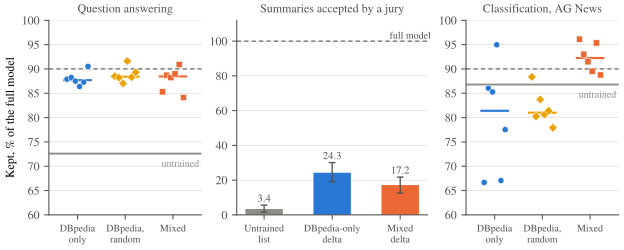
The answer depends on the task. Question answering comes back to about 88% of the full model. Summaries do not: a jury still rejects most of them. Classification is the surprise. It swings so much from one training seed to the next that a single run proves nothing, and the one clear gain comes from training on examples of the test task itself (Figure 1).
Solfird AI works on open-weight small models, and what a model must be trained for to run on a device decides what such a model should be. This report covers one model and short answers. The next report will widen it.
The report follows the order of the work. Section 2 describes the setup. Section 3 fixes a first recipe that never learned to stop. Section 4 measures the gain on question answering, and Section 5 reads the summaries with a jury. Section 6 measures how much classification moves between seeds. Section 7 asks whether training on one classification task helps another, and Section 8 runs the finished recipe once on new items. Section 9 gives the advice, Section 10 the limits, and Section 11 the earlier work. Table 1 lists the results.
What is new here. Against the related work (Section 11), this report adds four things.
- A router-only delta that leaves the unmasked model unchanged. At 12 of 256 experts it lifts question answering from 72.6% to about 88% of the full model. The gain holds across six seeds for each of two training sets, and on new items. The closest work in setting, Temporally Extended MoE, trains a controller and adapters.
- A jury check of the trained summaries. Training recovers length and coverage and not support by the article. The jury accepts 17 to 24% as many summaries as from the full model, against 3.4% untrained.
- A measure of seed noise on classification. One recipe ranges over 28 points across six seeds. Single-seed classification claims are not evidence.
- A seen-against-unseen test with a control. Training on a task’s own examples helps that task, and a control that changes one factor shows the examples are the cause. The gain does not reach a task that was not in training.
| Question | Result | Evidence | Section |
|---|---|---|---|
| Does training lift question answering at 4.7% of the experts? | Yes: from 72.6% to a median of about 88%, near the 90% bar and not above it | Chose the recipe; held-out | 4, 8 |
| Are the summaries good? | No: a jury accepts 17 to 24% as many as from the full model, against 3.4% untrained | Held-out | 5 |
| Does the unmasked model change? | No: identical answers on every item in every run | Both | 2 |
| Is one seed of a classification result evidence? | No: the same recipe scores 66.7 to 95.0% across six seeds | Chose the recipe | 6 |
| Does training on a classification task help that task? | Yes, a little: the mixed arm is above the untrained list in all 7 paired comparisons, and a control shows the AG News examples cause it | Both | 7 |
| Does the gain reach a task that was not in training? | No gain shown on emotion | Both | 7, 8 |
2 The setup
The router delta. The base model stays frozen. I train one extra matrix for each of the 40 MoE layers: 256 by 2,048 numbers, 21 million in all, 84 MB. It adds a learned correction to the router’s scores, and only when the short list is on (Figure 2). With the list off, the generated answers are identical to the base model’s. I checked this on all 1,200 items of every run I report (four tasks of 300 items each).
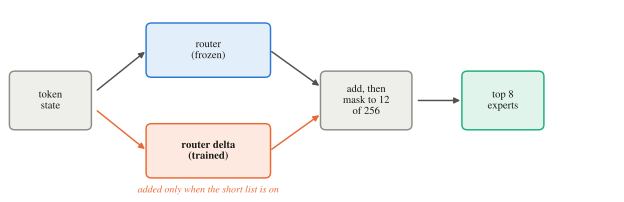
Teacher and loss. The teacher is the same model with no list. The student is the same model on the short list. The loss measures how far the student’s next-token probabilities are from the teacher’s, over the teacher’s own answer, in one pass. A small second term, with weight 0.01, keeps the corrected router’s choices on the prompt tokens close to the original router’s. The end token is part of the loss, so the model learns to stop (Section 3). I use no outside model and no output of any other vendor’s model for training.
The short list in use. The list is picked and refreshed as in the first report: from the first and last 32 prompt tokens when the prompt is read, then every 32 answer tokens from the router weights of the tokens just generated. Training uses the same lists.
Training data and the arms. The training items are the model’s own unmasked answers to 1,000 prompts for each of four tasks: summarization, question answering, classification and rewriting. Training is one pass over the 4,000 items, in 500 steps of 8 items, with a learning rate of 1e-4. It takes 1.5 to 2.5 hours on the laptop of the first report (an M3 Max with 48 GB, MLX 0.32.4, a 4-bit conversion of the model). The three arms differ only in the 1,000 classification items (Table 2). A seed sets the order in which the 4,000 items are shown.
| Arm | Classification items | Amount | Label order |
|---|---|---|---|
| DBpedia only, fixed order | DBpedia | 1,000 | Fixed |
| DBpedia only, random order | DBpedia | 1,000 | Random for every item |
| Mixed | DBpedia and AG News | 500 and 500 | Random for every item |
I ran the DBpedia-only arm and the mixed arm as a six-seed comparison. They differ in two ways: the second data source and the label order. So I added the middle arm afterwards, with six seeds and a reading rule written before its first run. It trains on the same 1,000 DBpedia items as the first arm, with the random label order of the third. The two comparisons it allows are in Section 7.
Items and scores. Table 3 lists the tasks. Each has 300 items per cell. I split the items of each source into three sets by position. Items 0 to 299 served to build the training data and the recipe. Items 300 to 599 chose the recipe and its budget, and every six-seed result of this report comes from them. Items 600 to 899 were kept out of every choice and out of all training; the first report ran the untrained list on them once. Summarization is not scored by ROUGE-L, because the first report showed that it stays high while a jury rejects most summaries.
| Task | Test items from | Score |
|---|---|---|
| Summarization | CNN/DailyMail | Accepted by a jury of three models (Section 5) |
| Question answering | SQuAD | F1, word overlap with the reference |
| Classification | AG News | Accuracy |
| Emotion | SetFit emotion | Accuracy |
Classification is read in two ways. In the listed order, the prompt shows the labels as written and the model writes its answer. In the rotated order, the first label moves to the end, and I read the model’s first-token scores for the labels. The rotated order tests whether the model follows the label and not its position.
Scores and the bar. Kept is a score divided by the full model’s score on the same items, in percent. Intervals are 95% percentile bootstrap intervals, paired with the full model’s answers, over items only, with 2,000 resamples. They do not include seed variance. Tables mark a result by the rule of the first report. It is above the bar of 90% when the whole interval lies above 90%, under the bar when the whole interval lies under 90%, and undecided otherwise. This is a screening rule: an interval that holds 90% means the data cannot tell the score from 90%, and does not show a score of 90% or more.
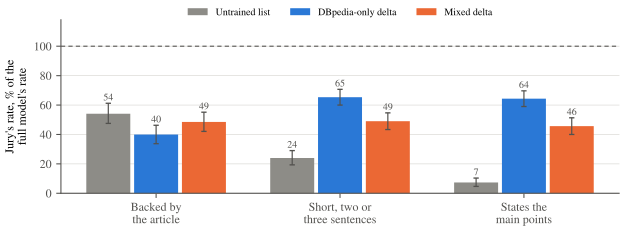
The jury. Three models read each summary next to its article and answer three yes-or-no questions: is every claim backed by the article, is it short, and does it state the main points. A summary is accepted when, on each question, at least two of the three jurors say yes. Appendix A names the jurors and gives their agreement.
Tests across seeds. I compare arms with an exact rank test (Mann-Whitney) on the six seeds of each. I fixed the test and its direction before the runs: one-sided, in the direction I expected. Where I report a correction for several tests, it is the Holm correction.
Checks on the data. Before this report, I checked every training text against every test text for runs of 12 identical words, with the prompt templates removed. Of the items that I score, none for question answering, rewriting or emotion shares a run with a training text. One summarization item does, and nine AG News items do, all against the AG News training items of the mixed arm. They are near-duplicates between the AG News training and test splits. Dropping the five that fall in items 300 to 599 changes no conclusion (Appendix B). Before each test I wrote down what would count as holding or failing.
3 Step 1: a first recipe never learned to stop
Evidence: items 300 to 599, one seed, 16 of 256 experts.
I wanted to know whether training the router works at all.
The first recipe made the model run on past its answer. It left the end token out of the loss. Nearly half of the trained model’s answers to questions were longer than the full model’s, and question answering fell far below the untrained list (Table 4).
Putting the end token into the loss, with two smaller changes, fixed it. I added the end token, with the teacher’s answers that stopped, and kept the one-token answers that the first recipe had dropped. The second recipe also trained for 500 steps instead of 430, and I did not separate the three changes. It brought question answering back to the untrained level and cut the looping. Every result after this step uses the second recipe.
With a recipe that stops, I could measure how much it lifts question answering.
4 Step 2: training lifts question answering, and the lift holds across seeds
Evidence: items 300 to 599, six seeds per arm, 12 of 256 experts.
I wanted to know how much training lifts question answering at the smallest list, and whether the lift survives a change of seed.
Training lifts question answering from 72.6% to about 88% of the full model. The two training sets lift it by about the same amount. It sits near the 90% bar and not above it (Table 5).
Training also cuts the looping summaries. Looping falls from 26.3% to a few percent. This does not make the summaries good (Section 5).
The lift holds for every seed. The two arms do not differ on question answering: their medians are 87.7 and 88.5%, and the rank test gives a two-sided \(p\) of 0.82. Per seed, the score reaches 90% in 2 of 12 seeds, and the interval holds 90% in 10 of 12 (Table 6). In two mixed-arm seeds the whole interval lies under 90%. No seed falls below about 84%.
| Arm | Seed 0 | Seed 1 | Seed 2 | Seed 3 | Seed 4 | Seed 5 |
|---|---|---|---|---|---|---|
| DBpedia only | 87.9 | 88.2 | 87.5 | 86.4 | 87.3 | 90.5 |
| Mixed | 85.3 ▼ | 88.7 | 88.2 | 89.0 | 90.9 | 84.1 ▼ |
Question answering is a short answer. Next I looked at what training does to a longer one, a summary.
5 Step 3: a jury accepts few of the trained summaries
Evidence: items 600 to 899, which no trained delta had seen; one seed per delta.
I wanted to know whether the trained summaries are good.
A jury accepts 17 to 24% as many trained summaries as full-model summaries. The DBpedia-only delta gets 24.3% and the mixed delta 17.2%, against 3.4% with no training (Table 7). Every row is under the bar.
| Summaries from | Accepted (%) | Accepted kept (%) | Backed | Short | Main points |
|---|---|---|---|---|---|
| Untrained list | 3.0 | 3.4 [1.5, 5.6] ▼ | 54.1 | 24.0 | 7.3 |
| DBpedia-only delta | 21.7 | 24.3 [19.0, 30.1] ▼ | 39.9 | 65.3 | 64.3 |
| Mixed delta | 15.3 | 17.2 [12.5, 21.8] ▼ | 48.5 | 49.0 | 45.7 |
Training brings back much of what a summary looks like and not whether it is true. The summaries become shorter and cover more of the main points, which are two of the jury’s questions. They do not become more faithful to the article. For the DBpedia-only delta, the share that the jury finds backed by the article is lower than with no training (Figure 3). I did not test why.
Summaries are the weakest result of this report. The next surprise was in classification, where the seed mattered most.
6 Step 4: one seed of a classification result is not evidence
Evidence: items 300 to 599, six seeds per arm.
I wanted to know how much classification moves when only the training seed changes.
The same recipe scores from 66.7 to 95.0% on AG News. That is a range of 28.3 points, from a change in the order of the training items alone (Figure 4). Any single-seed classification number from this recipe carries a band of about 20 points, and summarization and question answering do not show it.
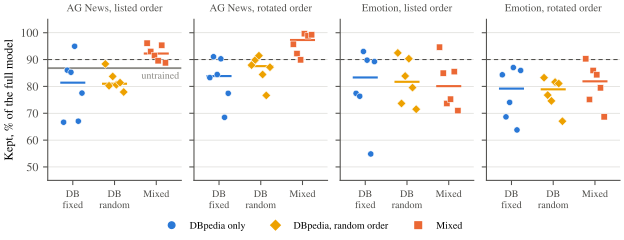
Most seeds of the DBpedia-only arm score under the untrained list. The untrained list scores 86.8% on AG News, and in five of the six seeds of the DBpedia-only arm the trained list scores lower, though the intervals overlap. On Gemma 4 the same recipe gave 69.9 and 91.1% on two seeds.
Two earlier single-seed results could not be read. A recipe that trains classification on three datasets that share no label with the test scored 81.8% on AG News, no better than the second seed of the DBpedia-only recipe (86.0%). And a larger list did not help: classification scored 86.4% at 16 of 256 experts and 78.7% at 24, though the larger list gives the model more experts. Both gaps sit inside the seed range. This is why I report seeds, not budgets, for classification.
So a comparison of arms on classification needs six seeds. I used six to ask whether training on a task’s own examples helps.
7 Step 5: training on a task’s own examples helps that task and not the other task I tested
Evidence: items 300 to 599, six seeds per arm; the rank tests were fixed before the runs.
I wanted to know whether training on AG News examples helps AG News, and whether it helps a classification task that was not in training.
Training on AG News examples raises AG News accuracy. The mixed arm replaces 500 of the DBpedia examples with 500 AG News examples. Its median score on AG News is 92.2%, against 81.4% for the DBpedia-only arm, and 97.3 against 83.9% in the rotated order (Table 8). The gain is expected: the mixed arm has seen the test’s task and dataset, and the DBpedia-only arm has not.
| Median kept (%) | Rank test \(p\), first over second | |||||
|---|---|---|---|---|---|---|
| Task | Fixed | Random | Mixed | Mixed, fixed | Random, fixed | Mixed, random |
| AG News, listed order | 81.4 | 81.0 | 92.2 | 0.013 | 0.409 | 0.001 |
| AG News, rotated order | 83.9 | 87.5 | 97.3 | 0.004 | 0.254 | 0.003 |
| Emotion, listed order | 83.3 | 81.7 | 80.1 | 0.71 | – | – |
| Emotion, rotated order | 79.2 | 78.9 | 81.9 | 0.31 | – | – |
The gain is real against the untrained list too. Paired on the same items, all six mixed-arm seeds score above the untrained list on AG News, by 1.7 to 8.0 points of accuracy, and in three of the six seeds the interval excludes zero (Table 9). The DBpedia-only arm shows no such effect. Three of its seeds are clearly below the untrained list.
| Arm | Seed 0 | Seed 1 | Seed 2 | Seed 3 | Seed 4 | Seed 5 |
|---|---|---|---|---|---|---|
| DBpedia only, fixed order | \(-\)17.3 ▼ | \(-\)0.7 | \(-\)1.3 | +7.0 ▲ | \(-\)17.0 ▼ | \(-\)8.0 ▼ |
| DBpedia only, random order | +1.3 | \(-\)5.7 | \(-\)2.7 | \(-\)5.3 ▼ | \(-\)4.7 ▼ | \(-\)7.7 ▼ |
| Mixed, random order | +8.0 ▲ | +5.3 ▲ | +4.0 | +2.3 | +7.3 ▲ | +1.7 |
The gain comes from the data, not from the label order. The mixed arm differs from the first arm in its data and in its label order. So I trained the control arm: the DBpedia items with a random label order. Random order alone does not lift AG News. The control’s median is 81.0% against 81.4%, and it sits at or below the untrained list: in five of six seeds it is lower, with a median of \(-5.0\) points. The mixed arm is clearly above the control (Table 8). So the reading rule, fixed before the run, gives the examples as the cause. The design could see a gap of about 12 points on the generated answer and 9 on the probe, so a small effect of the order is not excluded.
The gain does not reach emotion. Emotion is a classification task that no arm trains on. The arms do not differ on it, in either order. The seed spread on emotion is large, 14 points of standard deviation for the DBpedia-only arm and 9 for the mixed arm, so six seeds cannot exclude a gap under about 15 points. The result is no difference detected, on one unseen task.
After a correction for several tests, the rotated AG News gain is borderline. The two AG News tests have two-sided \(p\) of 0.026 and 0.009. Corrected over the six two-sided tests of this study (the two classification tasks in each order, question answering, and the summary overlap score), they give 0.130 for the listed order and 0.052 for the rotated order. The rotated one sits just above 0.05, and I take it as the primary reading. A first test on four and three seeds gave a \(p\) near 0.11, so I added seeds up to six per arm. The seed count was therefore not fixed in advance.
I then ran the finished recipe once on items that nobody had used.
8 Step 6: one run on items no trained delta had seen
Evidence: items 600 to 899, one new seed per trained arm, run once after the recipe was fixed.
I wanted to know whether the gains repeat on new items. One seed per arm means the intervals cover item sampling and not seed variance.
The question-answering gain repeats on new items. The untrained list scores 73.2% here, against 86.6 and 88.2% for the two deltas (Table 10).
The classification gain repeats in direction, and the intervals are too wide to call it. Paired on the same items, the differences from the untrained list are \(+2.0\) [\(-3.0\), 6.7] and \(+4.3\) [\(-0.3\), 9.0] points, both positive and both including zero.
On emotion, the untrained list scores as well as or better than both deltas. This agrees with Section 7. The emotion items here are 300 other items than in the six-seed study.
| Arm | QA (F1) | Classify | Emotion, listed | Emotion, rotated |
|---|---|---|---|---|
| Untrained list | 73.2 [68.5, 77.7] ▼ | 89.0 [84.6, 93.3] | 103.2 | 91.6 |
| DBpedia only | 86.6 [82.2, 91.0] | 91.3 [86.6, 95.9] | 91.9 | 77.9 |
| Mixed | 88.2 [83.8, 92.7] | 94.1 [89.6, 98.8] | 95.1 | 91.1 |
The mixed arm loops more on rewriting here than in any of its six earlier seeds. The rate is 9.0%, against 2.7 to 6.7%. I did not test the cause.
That ends the experiment. What follows is what I would do with it.
9 What to do
A router delta trained on the model’s own answers lets Qwen3.6 run on 12 of 256 experts per layer and keep question answering near 88% of the full model, where the untrained list kept 72.6%. That gives three pieces of advice and one direction.
Train the router for short-answer tasks. The delta costs 84 MB, leaves the model unchanged when the list is off, and takes 1.5 to 2.5 hours on a laptop. The gain holds across seeds and on new items. Confirm it on your own task before you rely on it.
Do not expect good summaries from this recipe. A jury accepts 17 to 24% as many summaries as from the full model. Training moves the form of a summary toward the full model’s, and not its support by the article. Judge generated text with a jury or a person, and not with ROUGE-L.
Run at least six seeds before you claim a classification result. The same recipe ranges over 28 points across seeds. If you want a gain on a classification task, train on examples of that task, and add a control that changes one factor.
The next step is to find what restores support in a summary, and to test the other two models with seeds.
10 Limits
One model, one budget. All six-seed results are for Qwen3.6-35B-A3B at 12 of 256 experts. Gemma 4 appears only in the two-seed comparison of Section 6, and The 12 seeds of Section 4 are six of each of two training sets, not twelve runs of one recipe.
The jury is made of models. Three model judges read the summaries, and no person graded them. Two jurors give the same accept-or-reject verdict on only 46 to 53% of the 1,200 summaries they judged, so the whole jury is the measure here, as in the first report. The jury check has one seed per delta.
Seed tests use the items that chose the recipe. Every six-seed test uses the same 300 items per task, which also served to choose the recipe. They show seed variance on those items and not on other items. The intervals ignore seed variance. The tables do not correct the rank tests for several tests; the correction is in the text.
The control cannot see small effects. At 80% power and a one-sided 0.05 level, it sees gaps of about 12 points on the generated answer and 9 on the probe. A small effect of the label order is not excluded.
Scope. Long answers are not covered: the first report shows where they break. The 4.7% is the size of the list at one time. Over a whole answer, with the list refreshed as it is written, the trained runs load about 18 of 256 experts per layer. I did not measure device memory or speed with the trained delta. Training and generation ran on one laptop.
11 Related work
Small expert sets. Three works are closest. Stepped MoE [2] pretrains a model to use one set of experts per segment, picked by a learned selector. SwapMoE [3] puts a hard cap on the memory of off-the-shelf models without changing their weights and updates the set from time to time. Temporally Extended MoE [4] masks an existing checkpoint, gpt-oss-20b, and renormalizes inside the allowed set as I do, but it trains a controller and LoRA adapters, and reaches up to 90% of base accuracy when it switches sets on fewer than 5% of tokens. The first report [1] measured frozen models on a short list and left training for this report.
Training the router. ReMoE [5] fine-tunes the router and warns that it tolerates forced changes only up to a point. Wu et al. [6] train extra routers and the model itself, and note that better caching does not guarantee the same task behavior. Work on expert pruning points to a mismatch between the router and the changed experts [7], and a trained correction on the router is aimed at that gap. This report trains only a delta on the router scores, active only under the list.
Judging summaries. On CNN/DailyMail, See et al. [8] already note that the Lead-3 baseline is hard to beat, and SummEval [9] and FRANK [10] find that ROUGE tracks consistency and factuality poorly. Maynez et al. [11] and Kryściński et al. [12] argue that overlap does not capture faithfulness. The first report found the same for masked MoE models, so this report judges summaries with a jury of models and does not use ROUGE. Model judges have known biases [13, 14], so a jury is also a proxy (Section 10).
Availability
Code and data are available on GitHub: https://github.com/solfird/moe-router-delta.
Acknowledgments
This work had no funding from any model vendor, and none reviewed it. I chose the question and the models, decided which experiments to run, and reviewed the results and the text. I used generative AI to draft this text. One of the jurors, Claude Haiku 5.5, comes from the vendor of the AI tool I used. All errors are mine.
References
[1] Julien Simon. Short answers survive, long answers break: Running a frozen Mixture-of-Experts model on a short list of experts. Technical Report 2026-02, Solfird AI, 2026.
[2] Arnav Kundu, Zhaoyang Xu, Bairu Hou, Chang Gao, Reed Li, and Tao Lei. Stepped MoE: Segment-level routing with configurable inference complexity. arXiv:2610.07348, 2026.
[3] Rui Kong, Yuanchun Li, Qingtian Feng, Weijun Wang, Xiaozhou Ye, Ye Ouyang, Linghe Kong, and Yunxin Liu. SwapMoE: Serving off-the-shelf MoE-based large language models with tunable memory budget. arXiv:2308.15030, 2023.
[4] Zeyu Shen and Peter Henderson. Temporally extended mixture-of-experts models. arXiv:2604.20156, 2026.
[5] Xiongwei Zhu, Xiaojian Liao, Tianyang Jiang, Yusen Zhang, Liang Wang, and Limin Xiao. ReMoE: Boosting expert reuse through router fine-tuning in memory-constrained MoE LLM inference. arXiv:2605.27081, 2026.
[6] Zhenhe Wu, Yaping Jin, Qinghua Xing, Hang Zhou, Wei He, Xianjie Wu, Xianfu Cheng, Jian Yang, and Hanting Chen. Cache-aware joint router adaptation for memory-efficient MoE inference. arXiv:2609.04895, 2026.
[7] Sieun Hyeon and Jaeyoung Do. Is retraining-free enough? the necessity of router calibration for efficient MoE compression. arXiv:2603.02217, 2026.
[8] Abigail See, Peter J. Liu, and Christopher D. Manning. Get to the point: Summarization with pointer-generator networks. arXiv:1704.04368, 2017.
[9] Alexander R. Fabbri, Wojciech Kryściński, Bryan McCann, Caiming Xiong, Richard Socher, and Dragomir Radev. SummEval: Re-evaluating summarization evaluation. arXiv:2007.12626, 2020.
[10] Artidoro Pagnoni, Vidhisha Balachandran, and Yulia Tsvetkov. Understanding factuality in abstractive summarization with FRANK: A benchmark for factuality metrics. arXiv:2104.13346, 2021.
[11] Joshua Maynez, Shashi Narayan, Bernd Bohnet, and Ryan McDonald. On faithfulness and factuality in abstractive summarization. arXiv:2005.00661, 2020.
[12] Wojciech Kryściński, Bryan McCann, Caiming Xiong, and Richard Socher. Evaluating the factual consistency of abstractive text summarization. arXiv:1910.12840, 2019.
[13] Lianmin Zheng, Wei-Lin Chiang, Ying Sheng, Siyuan Zhuang, Zhanghao Wu, Yonghao Zhuang, Zi Lin, Zhuohan Li, Dacheng Li, Eric P. Xing, Hao Zhang, Joseph E. Gonzalez, and Ion Stoica. Judging LLM-as-a-judge with MT-Bench and Chatbot Arena. arXiv:2306.05685, 2023.
[14] Ryan Koo, Minhwa Lee, Vipul Raheja, Jong Inn Park, Zae Myung Kim, and Dongyeop Kang. Benchmarking cognitive biases in large language models as evaluators. arXiv:2309.17012, 2023.
A Jury design
The jurors and the questions. The jurors are GPT-5.6 Luna, Gemini 3.5 Flash-Lite, and Claude Haiku 5.5, the last from the vendor of the AI tool I used. Each reads a summary next to its article, with no hint of its source, and answers three yes-or-no questions. Is every claim backed by the article? Does the summary give the main points in about two or three sentences? Does it state the main points? A summary is accepted when, on each question, at least two of the three jurors say yes.
Agreement. The three jurors accept 69, 98 and 88% of the full model’s summaries. Two jurors give the same accept-or-reject verdict on only 46 to 53% of the 1,200 summaries they judged: 300 each from the full model, the untrained list and the two trained deltas. That is a limit of model judges, and it is why the whole jury, and not any one juror, is the measure. Accepted kept is the accepted share of the masked summaries over that of the full model on the same items, with a 95% bootstrap interval. The paid API calls of the jury check cost $0.82 in all.
B Checks on the data
Where the items come from. The summarization and rewrite items are BBC articles from the XSum training split. The question-answering items come from the MRQA training split with its SQuAD part removed. The classification items come from the DBpedia and AG News training splits. The test items come from the CNN/DailyMail test split, the SQuAD validation split, the AG News test split and the emotion test split.
The overlap check. I compared the training texts with the test texts for runs of 12 identical words, with the prompt templates and instructions removed, so that article text is compared with article text. Over whole splits, 9 of 11,490 CNN/DailyMail test items, 5 of 10,570 SQuAD validation items, 113 of 7,600 AG News test items and none of 2,000 emotion items share a run with a training text. Among the items I score, no question-answering, rewrite or emotion item does. One summarization item in items 600 to 899 does. Nine AG News items do, five in items 300 to 599 and four in items 600 to 899, all against the 500 AG News training items of the mixed arm. They are near-duplicates between the AG News training and test splits. With the five from items 300 to 599 dropped from every arm, the median of the mixed arm is 92.1%, against 81.3% for the DBpedia-only arm and 81.1% for the control, with the same \(p\) of 0.013, and the paired gains are \(+4.7\), \(-4.6\) and \(-4.7\) points.
C Every classification seed
| Task | Arm | Kept (%), seeds 0 to 5 |
|---|---|---|
| AG News, listed order | DBpedia only, fixed order | 66.7, 86.0, 85.3, 95.0, 67.1, 77.5 |
| DBpedia only, random order | 88.4, 80.2, 83.7, 80.6, 81.4, 77.9 | |
| Mixed, random order | 96.1, 93.0, 91.5, 89.5, 95.3, 88.8 | |
| AG News, rotated order | DBpedia only, fixed order | 83.3, 91.1, 84.4, 90.3, 68.5, 77.4 |
| DBpedia only, random order | 87.9, 89.9, 91.4, 84.4, 76.7, 87.2 | |
| Mixed, random order | 95.7, 92.2, 89.9, 99.6, 98.8, 99.2 | |
| Emotion, listed order | DBpedia only, fixed order | 77.4, 76.3, 93.0, 89.8, 54.8, 89.2 |
| DBpedia only, random order | 92.5, 73.7, 83.9, 90.3, 79.6, 71.5 | |
| Mixed, random order | 94.6, 84.9, 73.7, 75.3, 85.5, 71.0 | |
| Emotion, rotated order | DBpedia only, fixed order | 84.3, 68.6, 74.1, 87.0, 63.8, 85.9 |
| DBpedia only, random order | 83.2, 76.8, 74.6, 81.6, 81.1, 67.0 | |
| Mixed, random order | 90.3, 75.1, 85.9, 84.3, 79.5, 68.6 |
D Numbers behind statements in the text
| Statement | Numbers | Section |
|---|---|---|
| The untrained list loops on summaries and rewrites | 26.3% and 18.7% at 12 of 256 experts | 1 |
| Two seeds are clearly under the 90% bar on question answering | 85.3 [80.9, 89.6] and 84.1 [79.8, 88.3], both mixed arm | 4 |
| The two arms do not differ on question answering | Two-sided rank test, \(p = 0.82\); medians 87.7 and 88.5 | 4 |
| The seed range of classification | 66.7 to 95.0%, a range of 28.3 points; Gemma 4, two seeds, 69.9 and 91.1% | 6 |
| Two earlier single-seed results | Three datasets with no shared label: 81.8%; second seed of the DBpedia-only arm: 86.0%; larger list: 86.4% at 16 of 256 experts, 78.7% at 24 | 6 |
| The AG News tests before correction | Listed order: one-sided \(p = 0.013\), two-sided 0.026; rotated order: one-sided 0.004, two-sided 0.009 | 7 |
| The control can see gaps of about | 12 points on the generated answer, 9 on the probe, at 80% power and a one-sided 0.05 level | 7 |
| Seed spread on emotion | Standard deviation 14 points (DBpedia only) and 9 (mixed); a gap under about 15 points is not excluded | 7 |
| Paired gain on classification, new items | \(+2.0\) [\(-3.0\), 6.7] (DBpedia only) and \(+4.3\) [\(-0.3\), 9.0] (mixed) points | 8 |
| Rewrite loops of the mixed arm on new items | 9.0%, against 2.7 to 6.7% in its six seeds | 8 |
| Jurors’ acceptance of the full model’s summaries | 69, 98 and 88% for the three jurors; two jurors agree on 46 to 53% of the verdicts | A |
| Size of the delta and time to train it | 21 million numbers, 84 MB; 1.5 to 2.5 hours on the laptop | 2 |
E Reproduction
Environment. Training and generation ran on one laptop (an M3 Max with 48 GB) with MLX 0.32.4, on a 4-bit conversion of Qwen3.6-35B-A3B from mlx-community. Each dataset keeps its own license.
Generation. Decoding is greedy with thinking off. Answers stop at 120 tokens for summaries, 32 for question answering, 8 for classification and 160 for rewriting. A loop is an answer whose last 24 tokens are one block of at most 12 tokens, repeated.
Scripts. The repository holds the training and generation script (c3b.py), the classification probes and their reports (clsprobe.py), the jury (jury_d.py), the overlap check (overlap_audit.py), and, in paper2/, check_numbers.py, make_figures.py and tables_gen.py. The last three print every number, figure and shaded table of this report from the result files, with no model and no network.