A mixture-of-experts language model saves compute but not memory, because any token can call any expert. Apple’s on-device model AFM 3 Core Advanced takes another path: Apple says it stores 20 billion parameters in flash, activates 1 to 4 billion at a time, and routes per prompt instead of per token. Apple has published no technical report on it. This report asks what that design costs in storage traffic and memory. I measure the shipped model from outside, on one M3 Max MacBook Pro, without opening any model file. Three results carry the answer. First, the expert store is one 4.95 GB file, read only in blocks of exactly 294,912 bytes; all 1807 traced reads fall on one grid of that stride, and one block is the size of three \(1536 \times 256\) matrices at 2 bits per weight. Second, storage load comes in bursts: first bursts reach 2.5 to 3.3 GiB/s for 15 to 24 ms, against a mean of 3.0 MiB/s, and bursts recur every 31 to 32 tokens on three prompts and irregularly on a long one. Third, Apple’s two inference processes hold 2.0 to 3.4 GiB, against 14 to 16 GiB for a 4-bit open mixture-of-experts build under MLX. The report also gives an attention-cache size that is inconsistent with the configuration in Apple’s latest routing paper, evidence of a Gemma-family tokenizer and of speculative decoding, latency against prompt length, and a preliminary energy comparison. Every statement is labeled as measured, derived, or inferred. The measurements support Apple’s description on every point they reach. All results come from one machine.
1 Introduction
Mixture-of-experts (MoE) models [1, 2] run a small share of their parameters for each token. Standard routing can change experts at every token, so all experts stay reachable in memory, and sparsity saves compute but not memory. Apple’s third-generation model, AFM 3 Core Advanced (Core Advanced below), takes another path. Apple’s description [3] says the full model stays in flash, because NAND-to-DRAM bandwidth is “too slow to swap weights token by token”, and that a small dense network selects a fixed set of experts for the prompt and reselects periodically during generation. I call this design flash-routed. Apple promised a technical report for summer 2026. At the time of writing, I found none in arXiv searches, on Apple’s publications page, or in a web search.
Solfird AI works on open-weight models, and this report measures a closed one for a reason. Core Advanced is the one shipped model of this design that I know of, and what the design costs in storage traffic and memory decides whether it is worth reproducing with open models. The measurements lead to one question: how far can an open MoE model, trained for per-token routing, run on a small selected set of experts? A companion report, Solfird AI Technical Report 2026-02, takes up that question.
This report gives what one Mac shows, in three kinds of statement, kept apart: measured (read from a tool), derived (arithmetic on measured values), and inferred (a reading that other explanations could also fit). It contributes a device-level trace of the expert store, with block size, on-disk grid, burst rate, and period in tokens (Sections 4.1 to 4.3); memory and latency at the same moments and on the same work as open builds (Sections 4.4 and 4.7); a preliminary energy comparison and accuracy on two benchmarks (Sections 4.5 and 4.6); one disagreement between the shipped system and a published configuration (Section 4.8); evidence of the Gemma tokenizer lineage and of speculative decoding (Sections 4.9 and 4.10); and public data and scripts for all but the raw traces [4]. Table 1 sets each result next to what Apple states.
| Apple’s statement | What one Mac shows | Grade | Section |
|---|---|---|---|
| 20 billion parameters, kept in flash | One 4.95 GB file; 19.79 billion weights if stored at 2 bits | D | 4.2 |
| 1 to 4 billion active at a time | At most 4.15 billion weights in memory, if two regions both hold weights | D | 4.2 |
| Experts selected for the prompt, not per token | First bursts of 152 to 228 blocks, then mostly 1 to 4 blocks | M | 4.1 |
| Reselected periodically | Bursts every 31 to 32 tokens on three prompts, irregular on a long one; a setting of 32 is not established | M, D | 4.3 |
| Flash too slow to swap per token | First bursts at 2.5 to 3.3 GiB/s for 15 to 24 ms; mean 3.0 MiB/s | M | 4.1 |
| Not stated | Every read is 294,912 bytes, on one grid; one block is the size of one expert at 2 bits | M, D, I | 4.2 |
| Not stated | Two processes hold 2.0 to 3.4 GiB, against 14 to 16 GiB for an open MoE build | M | 4.4 |
| Not stated | 35,840bytes of cache per token, which excludes a uniform cache of 12 KV heads | D, I | 4.8 |
| Not stated | Token counts match Gemma 3’s tokenizer on 429 of 429 strings | M | 4.9 |
| Not stated | Decode time follows the predictability of the text, which fits speculative decoding | M, I | 4.10 |
| Not stated | Energy at 35 to 36% of the lowest open build, without SSD and DRAM power (preliminary) | M | 4.5 |
2 Background
Apple’s line of work runs from flash-backed inference [5], which reports fast large linear reads and slow small random reads on Apple flash, to Instruction-Following Pruning [6], which fixes parameters per task to reduce weight loading. Stepped MoE [7] is the closest paper: its authors are at Apple, its arXiv listing names Apple Foundation Models in its comment field, and it reloads experts every \(S\) steps. Its described model has 56 layers, of which the first 12 are dense, a base dimension of 1536, expert dimension 256, grouped-query attention with 12 query and key-value (KV) heads, and 12 billion parameters. A 20-billion version appears only in an appendix, without its configuration. The paper does not name Core Advanced, so its configuration is a candidate for this model and not a fact about it. For earlier on-device models, Apple’s reports describe 8 KV heads [8], 2-bit quantization-aware training, and a design in which 62.5% of the layers produce the KV cache and the other 37.5% share it [9].
Apple’s one paper I found that names this model covers speech: Hwang et al. [10] report results at a 1-billion activation size and state that the routed experts are reselected periodically. A dictation paper [11] describes the same sparse design without naming the model.
Outside Apple, a line of work keeps per-token routing and moves experts between storage and memory: parameter offloading [12], CPU-GPU orchestration [13], cache-aware routing on phones [14], cross-layer prediction of the next experts [15], learned cache replacement [16], router fine-tuning for expert reuse [17], and speculative expert prefetching [18]. Kyung et al. [19] model the energy of such offloading to SSDs for server-scale models and estimate up to about 12 times the energy per token of an HBM baseline. Benazir and Lin [20] run MoE models on the Apple Neural Engine, and Bryngelson [21] reverse-engineer the engine itself; this report stays outside the system. Google’s Gemma 3n takes another route to low memory and keeps per-layer embeddings out of accelerator memory [22]. Measurement studies of on-device language models [23, 24] run models the authors can load; here the model is closed and shipped.
3 Method
Machine. MacBook Pro, Apple M3 Max (Mac15,9), 48GB, macOS 27.0.1 (build 26A434). I took all measurements on October 24 and 25, 2026. All energy runs ran on battery.
Tools. fs_usage, run as root, for the names, offsets, sizes, and durations of system calls and device reads by Apple’s main inference process; footprint and memory-map listings for memory (root for Apple’s processes); powermetrics at 250 or 500ms for CPU, GPU, and Neural Engine power (root); the unified log for loaded page counts; Apple’s fm command, its local server, and public Swift API. The repository also lists names that Apple’s frameworks export, read with dyld_info -exports; no result here depends on them. File and machine sizes are in GB and MB, as the tools report them; memory footprints and bandwidth are in GiB and MiB.
Scope. Apple’s license bars reverse engineering. I opened no model file, decompiled or disassembled nothing, dumped no memory, attached no debugger, and left System Integrity Protection on. The tools report names, sizes, offsets, timings, and counters, never the contents of a read.
Comparators. Open builds under MLX: Gemma 3 4B, Gemma 4 E4B, and Qwen3 4B at 4 and 8 bits, and Gemma 4 26B A4B at 4 bits (25.2 billion parameters, 3.8 billion active [25]), which MLX runs with standard per-token routing. The memory comparison depends on the MLX server used here, which holds the weights in memory and carries a Python runtime; a server that pages weights would change it.
Expectations written in advance. For five results I wrote down what I expected before the run, with a rule to confirm or refute it. Three were confirmed, one of them on a result that this report does not use, one was refuted, and one was inconclusive. The repository holds all five with their outcomes [4]. The results below are measurements and do not depend on them.
Data. The data, the logs, the scripts, and one record per finding are public at https://github.com/solfird/apple-fm-black-box, with a script that recomputes the main numbers from the data and a script that computes the derived numbers and the figures of this report. The measurement files there are a copy of the first release [4] at tag v1.0. Root traces need the same machine class and macOS build to repeat.
4 Results
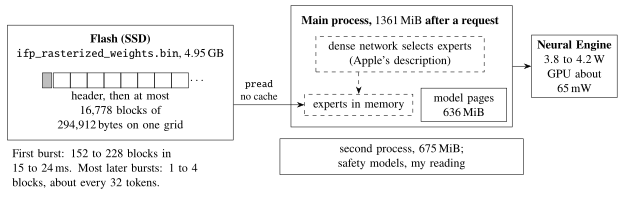
Figure 1 places the results of this section on the path from flash to the Neural Engine.
4.1 Reads from the expert store
The model pays for its experts once per prompt, not once per token. A cold prompt loads its experts in one burst of 15 to 24ms, about 5% of the time to first token, and then reads little: most later bursts hold 1 to 4 blocks. Over ten prompts, the reads touch 8.1% of the file, and only 26 of 1384 reads fetch a block a second time, so an expert that was loaded stays in memory. On this Mac, storage traffic is therefore a small cost of the design: it needs a fast SSD for a few hundredths of a second at the start of a prompt, and little after that. This is the behavior Apple describes, seen from outside.
Measured. The expert store is one file, ifp_rasterized_weights.bin, of 4,948,197,376bytes. The main process holds it open on a descriptor; a 49.5MB mapping of it also exists and took 29 page-ins of 16KiB. Over ten prompts on the first day, 17 threads of the main process made 1384 pread calls on that descriptor, every one exactly 294,912bytes, for 389.25MiB across 4654 generated tokens and 128.35s. The trace also records 1435 device reads of the file, 1333 of them exactly 294,912bytes, with a median duration of 0.64ms and a maximum of 3.26ms. The other 102 device reads sum to exactly 51 blocks, so the device reads total exactly 1384 blocks, the same count as the pread calls, prompt by prompt. The reads carry the no-cache flag, and no pread was served from the page cache. A second trace on the second day, for the runs of Section 4.3, adds 423 reads.
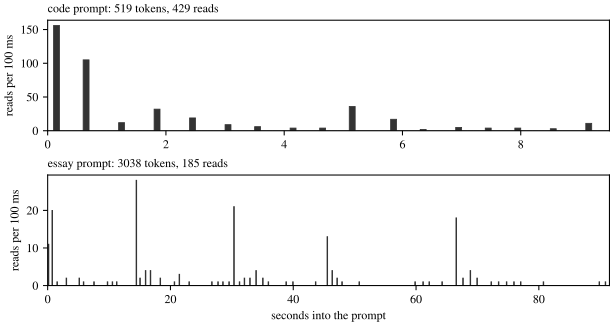
I call a run of reads with gaps under 0.12s a burst. First bursts on the first four prompts hold 152 to 228 blocks and last 15 to 24ms, from the first read’s issue to the last completion, at 2.5 to 3.3GiB/s (Table 2). Later prompts read 46 blocks or fewer in their first bursts. Figure 2 shows the read pattern of two prompts.
Derived. The mean is 87,700bytes per generated token and 3.03MiB/s, and it hides a cold start: the code prompt reads 429 blocks for 519 tokens and the later essay 185 blocks for 3038 tokens. The design’s load on storage is therefore short high-rate bursts, not the mean. The longest first burst is about 5% of the 0.47s time to first token measured on a 20-token prompt. On the code prompt, a second burst of 105 blocks follows at about 0.6s. The 1358 distinct offsets are 8.1% of the file’s blocks, and only 26 reads repeat an offset.
Inferred. Most later bursts hold 1 to 4 blocks, against first bursts of 152 to 228, so reselected experts were mostly already in memory. On a deterministic rerun of the essay, whose prompt names its topics in advance, the four large bursts fall 184 to 395 characters, about 35 to 74 tokens, before the next heading. I read this as a reselection ahead of a change of topic. A prompt that does not name its topics is untested.
| Prompt | Blocks | Duration (ms) | Rate (GiB/s) |
|---|---|---|---|
| Code | 156 | 17.4 | 2.46 |
| Math proof | 178 | 14.8 | 3.31 |
| French poem | 228 | 24.4 | 2.57 |
| Japanese list | 152 | 16.6 | 2.51 |
4.2 The on-disk layout
The trace is enough to recover the storage format without opening the file. Every read starts on one grid, the file is a header plus a whole number of blocks, and at 2 bits per weight it holds 19.79 billion weights, which matches Apple’s 20 billion. The sizes fit one reading: one block is one expert, with the dimensions of Stepped MoE, and loading an expert is one aligned read of fixed size. So the format serves the read pattern of Section 4.1, and the design in Apple’s routing paper is the best public guide to what is in the file.
Derived. My tables record each offset as its low 32 bits, so offsets beyond \(2^{32}\) wrap. All 1807 reads in the two traces (1384 in the first trace, 423 in the second) start at a multiple of 32KiB, and 294,912 is nine times 32KiB. Taken modulo 294,912, the recorded offsets give only two residues, 163,840 and 0. Since \(2^{32} \bmod 294{,}912 = 163{,}840\), the two residues are one residue seen before and after the wrap. As the wrap requires, every offset with residue 0 lies below 653,230,080, the size of the part of the file beyond \(2^{32}\).
Every read therefore falls on one grid of stride 294,912 with an origin at 163,840. The file size then factors exactly:
The trace cannot distinguish a 160KiB header from a larger one, such as 1MiB with 16,775 blocks. Blocks per routed layer cannot be read from the trace, because the header size is known only modulo 294,912.
The block size factors as the dimensions in Stepped MoE:
three matrices of \(1536 \times 256\) at 2 bits per weight, such as the gate, up, and down projections of one expert. At that width the file holds 19.79 billion weights, which matches Apple’s stated 20 billion. The log reports 40,680 loaded model pages of 16KiB (636MiB), at most 2.67 billion weights at 2 bits including any code in those pages. A 372MB buffer of unknown purpose would add at most 1.49 billion. Together the upper bound is 4.15 billion, if both regions hold weights; this is consistent with Apple’s 1 to 4 billion and does not measure it.
Inferred. Each grid block is one expert’s weights at about 2 bits. Other shapes give the same byte count (\(3072 \times 128\) at 2 bits, or \(768 \times 768\) at 4 bits). The evidence is the convergence of grid, file size, file name, and Apple’s text, not a read of the contents. Reading whole blocks on a fixed grid fits the finding of Alizadeh et al. [5] that large reads are the fast case on this flash.
4.3 Reselection period
The model reselects its experts on a count of tokens, not on a clock: the spacing between bursts stays near 31 to 32 tokens while the spacing in seconds changes by a factor of 1.7. The value 32 itself is not established, and the long prompt does not settle it. My reading is that the period sets how fast the model can follow a change in the text, and that it adds little storage traffic, because most reselections read 1 to 4 blocks.
Measured. On a geology prompt and a long prompt, I streamed the same deterministic answers again with timestamps to place bursts at token positions, at a resolution of about 10 tokens. Geology has a period of 31 tokens at 45tokens/s. The long prompt (3872 tokens in, 910 out) has gaps of 19, 40, 31, 30, 40, 60, 40, 30, 90, 120, 71, 59, 40, 100, and 60, with a median of 40.
Derived. Burst spacing in seconds times mean speed gives a period of 32 tokens on the code prompt (0.559s at 58tokens/s) and 32 on the essay (0.97s at 33tokens/s). The period in tokens stays near 31 to 32 while the period in seconds changes by a factor of 1.7.
On the long prompt, the median spacing is 37.6 tokens by mean speed, or 40 by streamed position. The long prompt therefore neither confirms a period near 32 nor rules it out.
Inferred. The model reselects on a token count near 32, and a reselection that finds its experts in memory reads nothing, so long answers show multiples of the period. At this resolution, a period scan on the long prompt does not separate 32 from 24 or 34, so 32 is not established as a setting. Stepped MoE reports that \(S=16\) beats \(S=32\) on the four benchmarks of its segment-length ablation; if the shipped value is 32, Apple accepts that loss for fewer reads.
4.4 Memory
This is the result the design exists for. A model of 20 billion parameters holds 2.0 to 3.4GiB, in the range of open models of 4 billion parameters at 4 bits, and about 7.5 times less than an open MoE build of similar size two seconds after a request. Bit width explains a factor of about 2 of that gap. This test does not separate the rest between routing, runtime, and parameter count.
Measured. I measured memory with footprint before, during, and after one request of about 5000 prompt tokens (Table 3). The Core Advanced row sums the main process (1361MiB after the request) and a second process of 675MiB that I take to run Apple’s safety models. It stays at 2.0 to 3.4GiB at every moment measured. Gemma 4 26B A4B holds 15GiB two seconds after the request.
Derived. Two seconds after the request, Gemma 4 26B A4B holds about 7.5 times the memory of the two Core Advanced processes, or about 11 times that of the main process alone. Bit width accounts for a factor of about 2 if Apple’s weights are at 2 bits and the Gemma build at 4. The remainder mixes selected sets against all experts with differences in runtime and parameter count, and this test does not separate them. I did not measure Core Advanced’s footprint after minutes of rest.
| Model | Idle | During request | 2s after |
|---|---|---|---|
| Core Advanced, two processes | 2.8 | 3.4 | 2.0 |
| Gemma 3 4B, 4-bit | 3.0 | 4.5 | 3.4 |
| Qwen3 4B, 4-bit | 2.6 | 4.4 | 3.9 |
| Gemma 4 E4B, 4-bit | 4.5 | 5.9 | 4.6 |
| Gemma 3 4B, 8-bit | 5.2 | 6.5 | 5.6 |
| Qwen3 4B, 8-bit | 4.5 | 6.2 | 5.7 |
| Gemma 4 E4B, 8-bit | 8.0 | 9.4 | 8.1 |
| Gemma 4 26B A4B, 4-bit (MoE) | 14 | 16 | 15 |
4.5 Energy (preliminary)
On the processors that powermetrics covers, Core Advanced uses about a third of the energy of the lowest open build on the same 20 problems, and about half per solved problem, because it solves fewer. This comparison is preliminary: it rests on 20 problems and one run per set, and it omits SSD and DRAM power. I report it as a first reading, with its limits, and not as a result of the same strength as the read trace.
Measured. I measured energy above an idle baseline on the same 20 GSM8K problems through the same client (Table 4). For Core Advanced, the Neural Engine draws 4.2W in prefill and 3.8W in decode, with the GPU at about 65mW.
| Open builds at | Model | Solved (of 20) | Energy (J) | J/problem | J/solved problem |
|---|---|---|---|---|---|
| 8-bit | Core Advanced | 13 | 465 | 23.2 | 35.7 |
| Qwen3 4B | 20 | 1273 | 63.6 | 63.6 | |
| Gemma 3 4B | 19 | 1595 | 79.8 | 84.0 | |
| Gemma 4 E4B | 19 | 1942 | 97.1 | 102.2 | |
| 4-bit | Core Advanced | 13 | 530 | 26.5 | 40.7 |
| Qwen3 4B | 20 | 1530 | 76.5 | 76.5 | |
| Gemma 4 E4B | 19 | 1680 | 84.0 | 88.4 | |
| Gemma 3 4B | 18 | 1716 | 85.8 | 95.4 |
Derived. The Core Advanced total is 36% of the lowest open build in the 8-bit set and 35% in the 4-bit set; per solved problem, 56% and 53%. Across runs, the two Core Advanced totals against the two Qwen3 totals span 30 to 42%.
This result has five limits, in order of weight. First, powermetrics reports no SSD or DRAM power, so the figures omit the component this design relies on, and Kyung et al. [19] estimate that component as large for per-token offloading. Second, the comparison mixes hardware (Neural Engine against GPU) with model size and answer length, which I did not record, so it gives no energy per token. Third, \(n = 20\) with one run per set, and one Core Advanced request in each set was refused and counted as unsolved. Core Advanced’s mean CPU power also differs between its runs, 1235 and 2331mW. Fourth, comparators are dense, not MoE. Fifth, a third run, excluded because the Mac slept during it, moved the open builds’ energy by a factor of about 1.8 through a lower GPU clock, so the clock macOS selects can move this comparison by that much.
4.6 Accuracy
The design’s gain is in memory, not in accuracy on these two tests. Core Advanced trails all three open models of 4 billion parameters on GSM8K, 78 of 100 against 89 to 94, and sits inside their range on MMLU. These runs cannot say whether routing, training, or size is the cause.
Measured. On larger sets than the energy runs, with greedy decoding and the open builds at 8 bits, Core Advanced solves 78 of 100 GSM8K problems, against 89 to 94, with exact McNemar \(p \le 0.0074\) for each paired comparison. On 200 MMLU questions, Core Advanced answers 134 correctly, against 118 to 144 for the open builds with replies cut at the token cap. With the eight cut replies rerun uncapped, Qwen3 4B reaches 150 and beats Core Advanced (\(p = 0.017\)), Gemma 4 E4B reaches 140 (\(p = 0.44\)), and the win of Core Advanced over Gemma 3 4B stands (\(p = 0.023\)). Refusals (4 of 300) count as wrong. These runs do not separate the routing design from training or size.
4.7 Latency
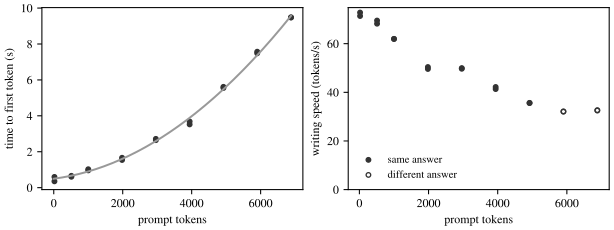
Long prompts are the weak point. Time to first token grows faster than linearly with prompt length, from 0.47s at 20 tokens to 9.48s at 6881, writing speed falls by half by 4921 prompt tokens, and a repeated prompt reuses no prefix. An application on this model therefore pays for its whole prompt on every request, and should keep it short.
Measured. In 18 runs from 20 to 6881 prompt tokens (Figure 3), the first token arrives after 0.47s at 20 tokens and 9.48s at 6881. A quadratic fit in the prompt length \(n\) gives, in seconds,
with \(R^2 = 0.998\) against \(0.951\) for a straight line, and a cubic term adds nothing. Writing speed falls from about 72tokens/s at 20 prompt tokens to about 36tokens/s at 4921. At the two longest lengths the model gave a different answer from the shorter runs; those runs are marked. I report the shape and do not assign a cause.
Three related results bound long prompts. Through fm serve, the same 2024-token prompt took 2.01s on its first run and 1.41s on every repeat, so requests reuse no prefix. The public API reports an 8192-token window: a prompt of 8102 tokens worked, and one of 8158 failed. Under a concurrent CPU load of 200GB/s of memory traffic, writing on a short prompt runs 9% slower and a 2000-token prefill 22% slower.
4.8 Attention cache
The shipped model’s attention is not the one in Apple’s latest routing paper. Two memory surfaces give 35,840bytes per token, a number with no factor of 3, so a uniform cache with 12 key-value heads cannot produce it. One layout that fits matches Apple’s earlier reports: 8 heads, a cache produced by 62.5% of the layers, and 8-bit values. So Stepped MoE is a guide to this model’s routing and not a description of its attention.
Measured and derived. Two memory surfaces have sizes of 293,601,280bytes and 18,350,080bytes. Divided by the context lengths 8192 and 512, both give 35,840bytes per token. \(35{,}840 = 2^{10} \times 5 \times 7\) has no factor of 3.
Inferred. Each surface is one key or value tensor at its context length. Then a uniform layout of full-context layers cannot contain 12 KV heads, and the configuration in Stepped MoE does not produce it. This excludes uniform layouts only: layers with fixed windows could sit in other surfaces. Layouts that fit include \(35 \times 8 \times 128 \times 1\) and \(56 \times 5 \times 128 \times 1\) (layers, KV heads, head dimension, bytes per value). In the first, 8 KV heads and head dimension 128 match the 2024 report [8], 35 is 62.5% of 56 as in the KV-sharing split of the 2025 report [9], and one byte per value means an 8-bit cache. This first layout is grouped-query attention (GQA), in which several query heads share one KV head. With a base dimension of 1536 and a head dimension of 128, the model would have 12 query heads, so 8 KV heads means that queries share keys and values, where the 12 and 12 of Stepped MoE share nothing. The trace measures neither the base dimension nor the number of query heads. The shipped model’s attention therefore likely differs from the 12-billion configuration that Stepped MoE describes in detail.
4.9 Tokenizer and embedding table
Core Advanced counts tokens exactly as Gemma 3 does, on every string tested, and holds a table with the size of Gemma 3’s vocabulary. So the model uses a tokenizer of Google’s Gemma family, with 775 slots changed. That is all this result shows: a shared tokenizer says nothing about weights, training data, or architecture.
Measured. On 429 strings, from code to sentences in 18 languages, Apple’s token counter matches Gemma 3’s tokenizer and Gemma 3n’s on all 429, Gemma 4’s on 425, and Gemma 2’s on 75.5%, against 20.7 to 44.5% for eight tokenizers from other labs. Of the 429 strings, 172 are private and not published. On the 257 public strings alone, which a reader can run again, the match is 257 of 257 for Gemma 3 and Gemma 3n, 253 for Gemma 4, 71.2% for Gemma 2, and 26.8 to 42.0% for the eight others. Google’s countTokens endpoint returned Apple’s count on all 257 public strings sent, under four model names, so it is not evidence for any one Google model. Of the 6242 placeholder slots <unusedN> in Gemma 3’s vocabulary, 5467 still count as one token and 775 do not. A persistent memory surface has 201,326,592bytes.
Derived. \(201{,}326{,}592 = 262{,}144 \times 768\), and 262,144 is the size of Gemma 3’s vocabulary [26]. A row of 768 bytes holds 1536 values at 4 bits, or 3072 at 2 bits.
Inferred. The surface is the embedding table, and a width of 1536 at 4 bits agrees with the base dimension in Stepped MoE. Apple took a Gemma-family tokenizer and reused 775 slots for its own markers. A shared tokenizer shows nothing about weights, training data, or architecture. One possible reason for it: Apple’s reports describe training on a teacher model [8, 9], an Apple executive is reported as saying the models were refined with outputs from Gemini [27], and logit-based distillation usually needs a shared tokenizer [28]. Training on a teacher’s generated text does not.
4.10 Runtime composition and speculative decoding
The cost of a token depends on the text: 9.9ms on repeated words and 23 to 25ms on prose, a factor of 2.3 to 2.5. That spread fits speculative decoding with the draft model that the log names, which Apple’s description of this model does not mention. So a throughput figure for Core Advanced holds only for the kind of text it was measured on.
Measured. The unified log names the assets of the main bundle: instruct_3b.base with variant generic_sparse, an adapter fm_api_generic_3b, a draft model, a tokenizer, and an image encoder. It names those of a second family: instruct_300m.base, instruct_300m.safety, instruct_300m.mm_guard, and their own tokenizer and image tokenizer. At one context bucket, time per decoded token is 9.9ms on repeated words, 13 to 15ms on counting, 17ms on code, and 23 to 25ms on prose.
Inferred. Plain greedy decoding costs the same for every token, so this spread fits a draft-and-verify loop [29] whose acceptance depends on how predictable the text is. Apple’s description of the model does not mention one; the 2025 report describes speculative decoding with a trained draft model for the previous on-device model [9]. The two use cases I exercised, the public API and content tagging, each load the base plus their own adapter, which fits per-use-case tuning on a shared base.
5 Discussion
The measurements support Apple’s description on every point they reach. For other model builders, the useful result is where the cost lands. Per-prompt routing loads a new set of experts in 15 to 24ms at 2.5 to 3.3GiB/s on this SSD. On a cold prompt the first reselection can load another two thirds of the first burst’s volume (105 blocks after 156 on the code prompt), after which storage traffic is small. A slower flash device would lengthen first bursts; by how much depends on whether the device or the reader threads set the rate, which these runs do not separate. So the design depends on burst bandwidth early in a prompt and asks for little sustained bandwidth.
6 Limitations and next measurements
One machine, one OS build, on a 48GB Mac far above the memory the model needs, so paging under pressure is untested. No iPhone, no Mac below M3, and no measurements of Core, the 3-billion-parameter model. Energy has the limits above. The raw fs_usage traces and the unified log capture are not published because they name Apple’s protected asset paths; the tables of reads, sizes, and offsets are public, so the grid result can be checked from them, but the device-read counts and burst durations cannot. Statements about why Apple chose something are mine. Apple can change any of this in a release, and its technical report may supersede these inferences.
Five measurements would close the largest gaps.
- Whole-system energy. An external power meter on AC power would include the SSD and DRAM, which powermetrics omits. Three or more runs per build, with answer lengths recorded, would give energy per output token.
- Memory pressure. The same trace on a Mac with 16GB or less, and under an artificial memory load, would show whether the expert cache shrinks and how read traffic and latency respond.
- Other hardware. Traces on an iPhone or a Mac below M3 would test whether the block, the grid, and the period carry over, and would show how burst rate tracks a slower flash device. These need a tracing path, and iOS may not offer one.
- Reselection period. Answers streamed token by token, instead of in blocks of about 10, would separate 32 from nearby values. Prompts that do not name their topics would test whether large bursts still come before a change of topic.
- Activation size. Apple states 1 to 4 billion active parameters by use case. Comparing read volume and memory across tasks that Apple assigns to different sizes would test this from outside.
One question goes beyond this system: how far an open MoE model, trained for per-token routing, can run on a small selected set of experts, and at what cost in answer quality. The memory gap in Table 3 is the reason to ask it.
Acknowledgments
This work had no funding from Apple or Google, and neither reviewed it. I chose the questions, ran the root traces, and reviewed the text. I used generative AI to draft this text. A public script recomputes the main numbers from the data. All errors are mine.
References
[1] Noam Shazeer, Azalia Mirhoseini, Krzysztof Maziarz, Andy Davis, Quoc Le, Geoffrey Hinton, and Jeff Dean. Outrageously large neural networks: The sparsely-gated mixture-of-experts layer. In International Conference on Learning Representations (ICLR), 2017.
[2] William Fedus, Barret Zoph, and Noam Shazeer. Switch Transformers: Scaling to trillion parameter models with simple and efficient sparsity. Journal of Machine Learning Research, 23(120):1–39, 2022.
[3] Apple. Introducing the third generation of Apple’s foundation models. https://machinelearning.apple.com/research/introducing-third-generation-of-apple-foundation-models, 2026. Published June 8, 2026, updated September 9, 2026, accessed October 24, 2026.
[4] Julien Simon. apple-fm-mac: Measurements of Apple’s on-device language model on a Mac. https://github.com/juliensimon/apple-fm-mac, 2026. Tag v1.0.
[5] Keivan Alizadeh, Iman Mirzadeh, Dmitry Belenko, Karen Khatamifard, Minsik Cho, Carlo C. Del Mundo, Mohammad Rastegari, and Mehrdad Farajtabar. LLM in a flash: Efficient large language model inference with limited memory. In Annual Meeting of the Association for Computational Linguistics (ACL), 2024. arXiv:2312.11514.
[6] Bairu Hou, Qibin Chen, Jianyu Wang, Guoli Yin, Chong Wang, Nan Du, Ruoming Pang, Shiyu Chang, and Tao Lei. Instruction-Following Pruning for large language models. In International Conference on Machine Learning (ICML), 2025. arXiv:2501.02086.
[7] Arnav Kundu, Zhaoyang Xu, Bairu Hou, Chang Gao, Reed Li, and Tao Lei. Stepped MoE: Segment-level routing with configurable inference complexity, 2026. arXiv:2610.07348.
[8] Apple. Apple Intelligence foundation language models, 2024. arXiv:2407.21075.
[9] Apple. Apple Intelligence foundation language models: Tech report 2025, 2025. arXiv:2507.13575.
[10] Dongseong Hwang, Prasanth Yadla, Kaan Elgin, Shifas Padinjaru Veettil, Sivanand Achanta, Dipjyoti Paul, Ramya Rasipuram, Tyler Johnson, Emad Soroush, Chung-Cheng Chiu, and Zhifeng Chen. Memory efficient audio synthesis with decoupled temporal depth diffusion transformers, 2026. arXiv:2607.23811.
[11] Prasanth Yadla, Mohammad Samragh, Dongseong Hwang, Mingbin Xu, Yuanyuan Zhang, Chung-Cheng Chiu, Yongqiang Wang, Yuan Liu, Zhen Huang, and Xiaodan Zhuang. Compressing streaming neural audio encoders via latent-space distillation, 2026. arXiv:2609.04102.
[12] Artyom Eliseev and Denis Mazur. Fast inference of mixture-of-experts language models with offloading, 2023. arXiv:2312.17238.
[13] Keisuke Kamahori, Tian Tang, Yile Gu, Kan Zhu, and Baris Kasikci. Fiddler: CPU-GPU orchestration for fast inference of mixture-of-experts models. In International Conference on Learning Representations (ICLR), 2025. arXiv:2402.07033.
[14] Andrii Skliar, Ties van Rozendaal, Romain Lepert, Todor Boinovski, Mart van Baalen, Markus Nagel, Paul Whatmough, and Babak Ehteshami Bejnordi. Mixture of cache-conditional experts for efficient mobile device inference. Transactions on Machine Learning Research, 2025. arXiv:2412.00099.
[15] Zhiyuan Fang, Zicong Hong, Yuegui Huang, Yufeng Lyu, Wuhui Chen, Yue Yu, Fan Yu, and Zibin Zheng. Fate: Fast edge inference of mixture-of-experts models via cross-layer gate. In The Web Conference (WWW), 2025. arXiv:2502.12224.
[16] Byeongju Kim, Jungwan Lee, Donghyeon Han, Hoi-Jun Yoo, and Sangyeob Kim. FlashMoE: Reducing SSD I/O bottlenecks via ML-based cache replacement for mixture-of-experts inference on edge devices, 2026. arXiv:2601.17063.
[17] Xiongwei Zhu, Xiaojian Liao, Tianyang Jiang, Yusen Zhang, Liang Wang, and Limin Xiao. ReMoE: Boosting expert reuse through router fine-tuning in memory-constrained MoE LLM inference. In International Conference on Machine Learning (ICML), 2026. arXiv:2605.27081.
[18] Duc Hoang, Ajay Jaiswal, Mohammad Samragh, and Minsik Cho. SpecMD: A comprehensive study on speculative expert prefetching, 2026. arXiv:2602.03921.
[19] Kwanhee Kyung, Sungmin Yun, and Jung Ho Ahn. SSD offloading for LLM mixture-of-experts weights considered harmful in energy efficiency. IEEE Computer Architecture Letters, 2025. arXiv:2508.06978.
[20] Afsara Benazir and Felix Xiaozhu Lin. Efficient mixture-of-experts LLM inference with Apple Silicon NPUs, 2026. arXiv:2604.18788.
[21] Spencer H. Bryngelson. Apple Neural Engine: Architecture, programming, and performance, 2026. arXiv:2606.22283.
[22] Google. Introducing Gemma 3n: The developer guide. https://developers.googleblog.com/en/introducing-gemma-3n-developer-guide/, 2025. June 26, 2025.
[23] Stefanos Laskaridis, Kleomenis Katevas, Lorenzo Minto, and Hamed Haddadi. MELTing point: Mobile evaluation of language transformers. In International Conference on Mobile Computing and Networking (MobiCom), 2024. arXiv:2403.12844.
[24] Jie Xiao, Qianyi Huang, Xu Chen, and Chen Tian. Understanding large language models in your pockets: Performance study on COTS mobile devices. IEEE Transactions on Mobile Computing, 2024. arXiv:2410.03613.
[25] Google. Gemma 4 model card. https://ai.google.dev/gemma/docs/core/model_card_4, 2026. Updated July 30, 2026, accessed October 25, 2026.
[26] Gemma Team. Gemma 3 technical report, 2025. arXiv:2503.19786.
[27] Chance Miller. Craig Federighi details Apple’s collaboration with Google for Siri AI in iOS 27. https://9to5mac.com/2026/06/08/craig-federighi-details-apples-collaboration-with-google-for-siri-ai-in-ios-27/, 2026. 9to5Mac, June 8, 2026, accessed October 24, 2026.
[28] Nicolas Boizard, Kevin El Haddad, Céline Hudelot, and Pierre Colombo. Towards cross-tokenizer distillation: the universal logit distillation loss for LLMs. Transactions on Machine Learning Research, 2025. arXiv:2402.12030.
[29] Yaniv Leviathan, Matan Kalman, and Yossi Matias. Fast inference from transformers via speculative decoding. In International Conference on Machine Learning (ICML), 2023. arXiv:2211.17192.